Your First 48 Hours in India: Surviving Delhi Before the Real Trip Starts
Airport SIM cards, jet lag strategy, and why you should not go to Old Delhi on Day 1
Destinations in this article
# Your First 48 Hours in India: Surviving Delhi Before the Real Trip Starts
Delhi is where most international trips to India begin. It is also where most travelers make their first three mistakes within an hour of landing.
They skip the SIM card counter. They get into an unmarked taxi. They try to go sightseeing at 3 PM on zero sleep. By dinnertime, they are lost, disconnected, and questioning their life choices.
Here is the hour-by-hour plan that prevents all of that.
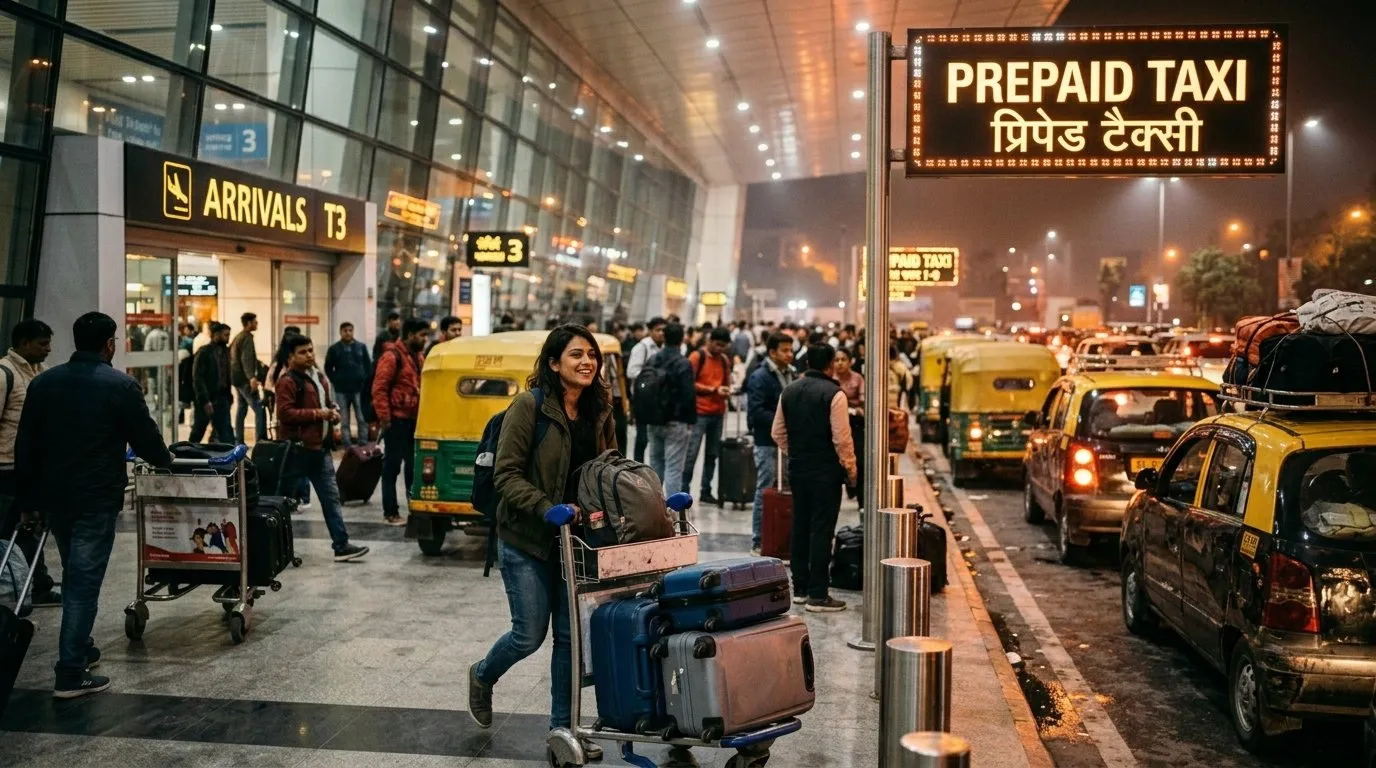
Hour 0: Landing at IGI Airport Terminal 3
Most international flights arrive between midnight and 5 AM. Terminal 3 is modern, clean, and well-organized. You will be pleasantly surprised — it does not match whatever mental image you have of India.
Immigration: Takes 20-60 minutes depending on your arrival time. Have your e-Visa printout ready. The officer will scan it, check your passport, and wave you through. No questions asked 95% of the time.
Baggage claim: Standard. Grab your bags.
Do these three things IMMEDIATELY before exiting the terminal:
1. SIM Card (15-30 minutes)
Airtel counter in the arrivals hall. Tell them you want the tourist plan. Cost: ₹500-700. You need: passport and one passport photo. They will photocopy your passport, fill out forms, and hand you a working SIM. Sometimes it activates instantly, sometimes it takes 2-4 hours.
Why this matters: without a local SIM, you cannot use Uber/Ola, you cannot use Google Maps, and you cannot WhatsApp your hotel. You are functionally stranded in a city of 20 million.
If the Airtel counter is closed (rare but possible at 2 AM), get a Jio SIM from the other counter. Both work fine.
2. ATM Withdrawal (5 minutes)
There are ATMs in the arrivals hall. Use an SBI, HDFC, or ICICI machine. Withdraw ₹10,000-20,000. This covers your first 2-3 days of cash needs — autos, street food, tips, small purchases.
If the ATM rejects your card: try another machine. Indian ATMs are temperamental with foreign cards. If none work, use the Thomas Cook currency exchange counter in arrivals.
3. Pre-Booked Transport (do NOT improvise)
The moment you exit arrivals, you will be swarmed by men shouting "Taxi sir! Best price sir! Where you going sir!"
Ignore all of them. This is not dangerous — it is just overpriced and annoying.
Your options, ranked:
1. Uber/Ola — If your SIM is active, book through the app. ₹400-800 to most Delhi hotels. Cheapest, tracked, safe.
2. Delhi Airport Metro Express — If arriving before midnight, the Orange Line metro goes to New Delhi Railway Station in 20 minutes (₹60). Efficient but not ideal with heavy luggage at 3 AM.
3. Pre-paid taxi counter — Inside the arrivals hall (before you exit). Government-run. Fixed rates displayed on a board. You pay at the counter, get a receipt, and they assign you a car. ₹500-800 to central Delhi. Not the cheapest but reliable and safe.
4. Hotel pickup — If your hotel offers airport transfer, take it. Usually ₹1,500-2,500. Overpriced but you get a guy holding a sign with your name, which is comforting at 3 AM in a new country.
NEVER get into an unmarked car. NEVER negotiate with the touts outside arrivals. NEVER believe anyone who says "the meter is broken" — there are no metered taxis at the airport anymore, which is precisely why you use the pre-paid counter or an app.
Hour 1-2: Getting to Your Hotel
Delhi traffic is legendary. At 3 AM? Empty roads, 30-minute drive to most central locations. At 8 AM? The same drive takes 90 minutes.
General estimates from airport to common hotel areas:
- ●Paharganj (backpacker area near New Delhi station): 45-60 min
- ●Connaught Place (central Delhi): 40-60 min
- ●Karol Bagh (mid-range hotels): 40-50 min
- ●South Delhi (Hauz Khas, Defence Colony): 30-45 min
- ●Aerocity (airport hotels): 5-10 min
If you are landing at 2-4 AM and have an early start planned, consider staying one night in Aerocity. Multiple good hotels within 10 minutes of the terminal. Prices: ₹3,000-8,000/night. Worth it for the sleep.
The Jet Lag Strategy
Your body thinks it is 3 PM. It is 3 AM in Delhi. You are wrecked.
The plan:
1. Arrive at hotel. Check in. Shower.
2. Sleep until 8-9 AM. Set an alarm. Do NOT sleep until noon.
3. Force yourself outside by 10 AM. Sunlight is the fastest jet lag cure.
4. Eat a real meal at lunch. Your appetite will be confused — eat anyway.
5. Stay awake until 9-10 PM. Take melatonin at 9 PM if needed.
6. Sleep. By tomorrow you will be 80% adjusted.
The critical mistake: Napping at 2 PM "just for an hour." You will wake up at 7 PM disoriented, eat dinner at 10 PM, lie in bed unable to sleep until 4 AM, and be useless on Day 2. Do not do this.
Day 1 Morning: Start Gentle
You are jet-lagged, overstimulated, and probably mildly dehydrated. Day 1 is not for Old Delhi. Old Delhi on Day 1 will break you. Start with places that are beautiful but calm.
Humayun's Tomb (9 AM)
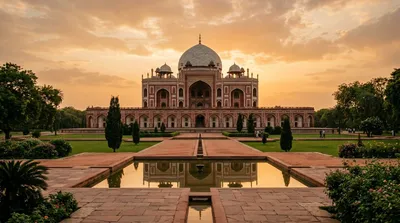
This is your gentle introduction to India. Built in 1570, it is the architectural precursor to the Taj Mahal. Red sandstone and white marble set in geometric Persian gardens. It is peaceful, photogenic, and not crowded before 10 AM.
- ●Entry: ₹600 for foreigners (₹35 for Indians — yes, the dual pricing is a thing, and yes, it is annoying)
- ●Time needed: 1-1.5 hours
- ●Tip: Enter through the main gate and walk the full garden perimeter before approaching the tomb itself. The perspective from the south garden is the best photograph.
Lodhi Garden (11 AM)
A 10-minute drive from Humayun's Tomb. 90 acres of manicured gardens with 15th-century tombs scattered throughout. Free entry. Joggers, families, couples, and one very photogenic rose garden.
This is where Delhi's middle class comes to walk. Nobody will hassle you. The energy is the opposite of what you expect from Delhi. Spend 45 minutes walking, sit on a bench, and let your body adjust to the climate.
Day 1 Afternoon: Qutub Minar Complex
The Qutub Minar is the tallest brick minaret in the world (72.5 meters), built starting in 1193. The complex around it includes the Iron Pillar of Delhi — a 1,600-year-old pillar that has barely rusted, which metallurgists still study.
- ●Entry: ₹600 for foreigners
- ●Time needed: 1.5-2 hours
- ●Getting there: Uber from Lodhi Garden, 30-45 minutes depending on traffic. Or take the Yellow Line metro to Qutub Minar station.
After Qutub, head to Hauz Khas Village (15-minute drive). This is South Delhi's creative district — cafes, bookshops, boutiques, and a 13th-century reservoir. Good for a coffee break and people-watching. Social (the restaurant/bar) has a terrace overlooking the ancient ruins.
Day 1 Evening: Dinner
Option A — Khan Market: Delhi's most upscale market. Good restaurants: Big Chill (pasta and desserts — sounds weird in Delhi, but it is an institution), Perch (wine bar), Amici (Italian). Safe, well-lit, walkable.
Option B — Connaught Place: The center of New Delhi. Circular colonial architecture. More chaotic than Khan Market but more authentically Delhi. Eat at: a veg-thali chain (Rajdhani or Govinda's, unlimited food around ₹600), Wenger's (Delhi institution bakery, since 1926), or any modern-Indian place in Connaught Place (₹1,200-1,800 per person).
Option C — Room service. Seriously. If you are exhausted, order food and go to bed. Nobody is grading your trip. Survival trumps sightseeing.
Day 2: Old Delhi Deep Dive
You have slept. Your SIM works. You know how to use Uber. You have cash. Now you are ready for Old Delhi.
Old Delhi (Shahjahanabad) was built by Emperor Shah Jahan in 1639. It is the densest, loudest, most sensory-intense neighborhood in India. It is also the most rewarding if you go at the right time.
8 AM: Chandni Chowk
The main bazaar of Old Delhi. At 8 AM, the shops are opening, the crowds are thin, and the morning light hits the havelis (merchant houses) at the perfect angle.
Walk this route:
1. Start at Chandni Chowk metro station
2. Walk west through the main bazaar
3. Turn into Paranthewali Gali for breakfast — stuffed paranthas (flatbreads) fried in ghee, served with pickle and curd. This specific alley has served paranthas since 1872. Get the aloo (potato) and gobhi (cauliflower). Cost: ₹100-150 per plate.
4. Continue to the spice market (Khari Baoli). The largest spice market in Asia. The smell hits you from a block away. Walk through, do not buy on the ground floor (tourist prices). The wholesale shops on upper floors are where the real trade happens.
10 AM: Jama Masjid
India's largest mosque, built by Shah Jahan in 1656. It holds 25,000 worshippers. Free entry (₹300 camera fee). Remove shoes, cover shoulders and knees.
Climb the southern minaret (₹100) for the best aerial view of Old Delhi. The stairs are narrow and steep. The view from the top — the red sandstone mosque below you, the chaos of Chandni Chowk spreading outward, the distant skyline of New Delhi — is worth the climb.
11:30 AM: Red Fort
The Mughal emperor's residence from 1648 to 1857. Massive red sandstone walls visible from Chandni Chowk. Allow 1.5-2 hours.
- ●Entry: ₹600 for foreigners
- ●Highlights: Diwan-i-Am (hall of public audience), Diwan-i-Khas (hall of private audience, where the Peacock Throne once sat), and the hamam (royal baths)
- ●Skip: The museum inside unless you are deeply into Mughal military history
1 PM: Lunch at Karim's
Down a narrow alley near Gate 1 of Jama Masjid. Mughlai food since 1913, recipes passed down from cooks who served in the Mughal court. The mutton burra kebab (₹350), chicken jahangiri (₹300), and rumali roti (₹30) are non-negotiable. It is not clean by Western standards. It is some of the best food you will eat in India.
Alternative if you want something lighter: Al Jawahar next door. Same quality, slightly less intimidating atmosphere.
Day 2 Afternoon: Choose Your Path
Option A — India Gate and Rashtrapati Bhavan:
The ceremonial heart of New Delhi. India Gate is a war memorial (think Arc de Triomphe). Rashtrapati Bhavan is the President's residence — the largest functioning presidential palace in the world. Rajpath (the grand boulevard connecting them) is impressive from a scale perspective. Best at sunset. Allow 1-1.5 hours.
Option B — Gurudwara Bangla Sahib:
A Sikh temple near Connaught Place. Gold dome, reflecting pool, and the most peaceful atmosphere in central Delhi. Free entry. Cover your head (free scarves available). The langar (community kitchen) serves free meals — simple dal and roti, eaten sitting on the floor. This is not a tourist experience; it is a daily act of Sikh service. Respectful visitors are genuinely welcome. Allow 45-60 minutes.
I would choose Option B. You will see grand monuments in Agra and Jaipur. You will not easily find another Gurudwara Bangla Sahib.
Day 2 Evening: Shopping
Dilli Haat (near INA metro station): An open-air market with stalls from every Indian state. Handicrafts, textiles, jewelry, art. Fixed prices displayed (no haggling required — this is the entire point). Entry: ₹30. The food stalls in the back serve regional cuisines from across India — Manipuri, Rajasthani, Kashmiri, Bengali. This is your best "taste of India" in one location.
Alternative: Sarojini Nagar Market — Delhi's famous street shopping market. Export surplus clothing at absurd prices (₹100-300 for branded items). Chaotic, loud, and fun if you enjoy bargain hunting. Saturday afternoons are peak madness.
What to Skip (Controversial Takes)
- ●Lotus Temple — Architecturally interesting (Bahai House of Worship, shaped like a lotus flower). But it takes 1.5-2 hours to reach in traffic, you queue for 30 minutes, and you spend 10 minutes inside a silent white room. Not worth the time cost in a 48-hour window.
- ●Akshardham — Genuinely impressive Hindu temple complex. But it takes half a day (no phones, no cameras, no bags allowed — you check everything at the entrance). Save it for a future trip when you have more time.
- ●Raj Ghat — Gandhi's memorial. A simple black marble platform where he was cremated. Important historically but there is not much to see. Five minutes is enough.
Real Costs: Your First 48 Hours
| Item | Cost |
|---|---|
| Airport SIM card | ₹500-700 ($6-8) |
| ATM withdrawal fee | ₹200-300 ($2-4) |
| Pre-paid taxi airport → hotel | ₹500-800 ($6-10) |
| Uber rides (per trip, central Delhi) | ₹200-400 ($2.50-5) |
| Auto-rickshaw CP → Old Delhi | ₹150-200 ($2-2.50) |
| Metro single journey | ₹30-60 ($0.35-0.70) |
| Humayun's Tomb entry | ₹600 ($7.20) |
| Red Fort entry | ₹600 ($7.20) |
| Qutub Minar entry | ₹600 ($7.20) |
| Breakfast at Paranthewali Gali | ₹100-150 ($1.20-1.80) |
| Lunch at Karim's (per person) | ₹400-600 ($5-7) |
| Dinner at Khan Market (per person) | ₹800-1,500 ($10-18) |
| Chai on the street | ₹10-20 ($0.12-0.24) |
| 1 liter bottled water | ₹20 ($0.24) |
Total 48-hour spend (excluding hotel): ₹4,000-7,000 ($48-84) per person.
Delhi is not expensive. It is overwhelming, dense, contradictory, and loud. But give it 48 hours on these terms and it will reward you. The rest of India gets easier after Delhi.
You survived the hardest part. The real trip starts now.
Monthly Scores
| Destination | Jan | Feb | Mar | Apr | May | Jun | Jul | Aug | Sep | Oct | Nov | Dec |
|---|---|---|---|---|---|---|---|---|---|---|---|---|
| Delhi | 6.0 | 8.0 | 8.0 | 6.0 | 2.0 | 2.0 | 4.0 | 4.0 | 6.0 | 10.0 | 8.0 | 6.0 |
The Window · Every Sunday
Liked this? Get one every Sunday.
Best score of the week, one honest skip, road updates. Four minutes. No spam.
More in
Bringing American-Born Kids to India: An NRI Family's Guide
Age-by-age strategies, health prep, food tactics, and the 5 kid-tested destinations that actually work — from an Indian-origin family in Canberra who makes this trip regularly.
8 min read
Two Weeks in India: The Family-Tested Itinerary That Doesn't Suck
Most two-week India itineraries pack in too many cities and not enough breathing room. This family-tested 14-day route covers Delhi, Agra, Jaipur, Amritsar, Dharamshala, and Varanasi with real costs at three budget levels.
12 min read
India for LGBTQ Travelers: An Honest 2026 Assessment
Section 377 was struck down in 2018. Same-sex activity is legal. Same-sex marriage is not. Here is the destination-by-destination reality for LGBTQ travelers in India — honest, no sugarcoating.
8 min read- Access
- Metro network excellent.
- Emergency
- 108 reliable · AIIMS, Safdarjung, Max, Fortis — world-class.
- Stay
- ₹500-50000/night · thousands options
Go with confidence.