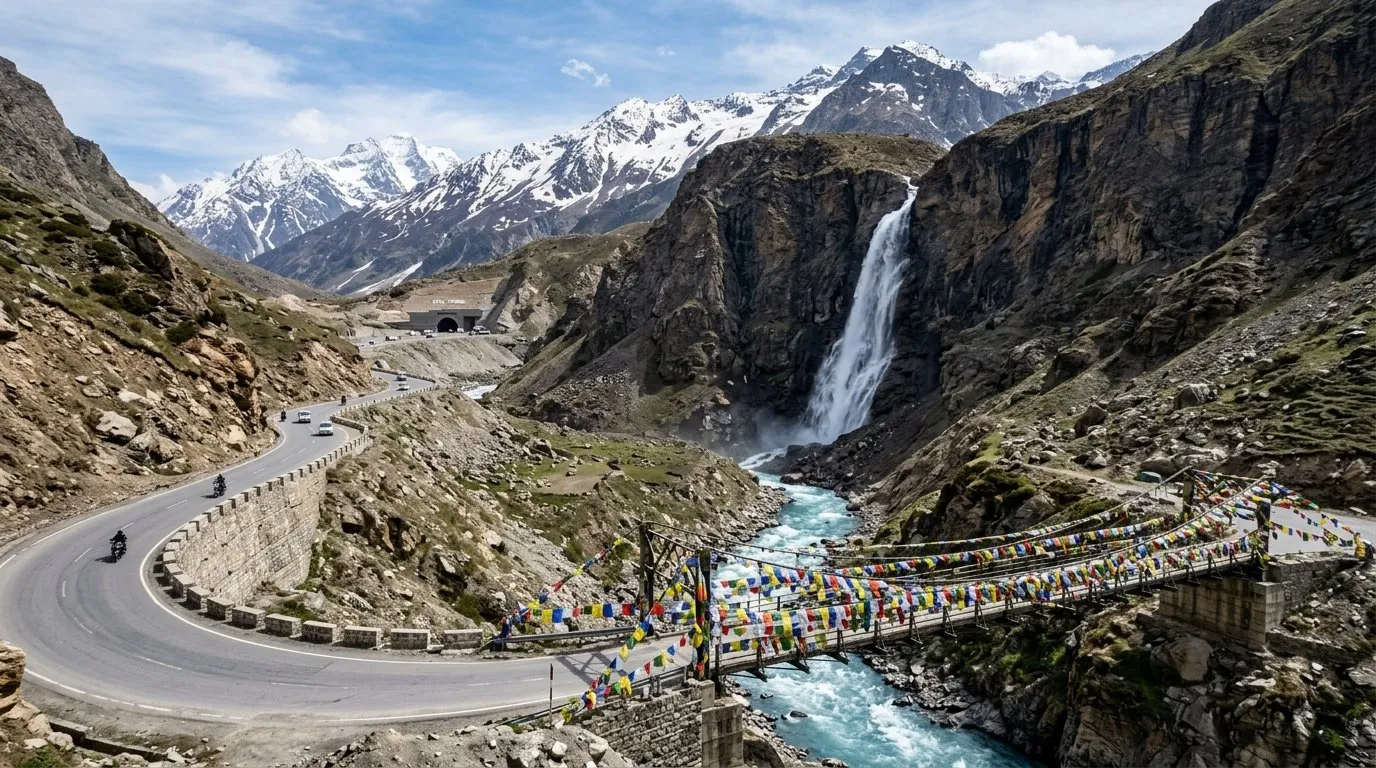
Complete Guide to Sissu
The first village after the Atal Tunnel — a waterfall crashes next to the highway and everything changes
Destinations in this article
Why Go
The moment you emerge from the Atal Tunnel — 9.02 km of darkness under the Rohtang Pass — the world changes. The green, rain-soaked Kullu Valley you left behind is gone. In its place: a stark, high-altitude valley with snow-capped peaks, thin air, and a completely different quality of light. And the first settlement you encounter in this new world is Sissu.
Sissu is a small village at 3,100 metres in the Lahaul Valley of Himachal Pradesh, and it has something that would be a major tourist attraction anywhere else: a massive waterfall that crashes directly beside the highway. The Sissu Waterfall (also called Khalsar Nala) drops from the mountainside in a white torrent that you can see — and hear — from your car window. There is no hiking required, no entry fee, no difficulty of access. You stop, you see it, and it is genuinely impressive, especially in June and July when snowmelt swells the flow to its peak.
But Sissu is more than a waterfall. It is the first real settlement in the Lahaul Valley, and it functions as a natural stopping point on three important routes: north to Keylong and Leh via the Manali-Leh highway, west to Spiti via Kunzum La, and south back through the Atal Tunnel to Manali. Before the tunnel opened in 2020, reaching Sissu required crossing Rohtang Pass — a nightmarish bottleneck open only June to October. Now the tunnel makes Sissu accessible year-round, transforming it from a seasonal waypoint into a genuine base camp for exploring Lahaul.
Gepang Goh lake, a high-altitude glacial lake accessible via a moderate trek from Sissu, adds another draw. And the village itself — traditional Lahauli architecture, Buddhist prayer wheels, apple orchards — provides a glimpse of a mountain culture that is distinct from both Kullu and Ladakh.
Best Month to Visit
May through October is the traditional season. The Atal Tunnel means you can technically reach Sissu year-round, but winter (November-March) brings heavy snow, sub-zero temperatures, and very limited services.
June-July: Best for the waterfall (peak snowmelt flow). Weather is pleasant — daytime 15-22°C. The Manali-Leh highway is opening, bringing traffic and energy to the valley.
August: Occasional rain and cloud cover from monsoon moisture that sneaks over the passes. The valley is at its greenest.
September-October: Autumn brings clear skies, golden light, and fewer tourists. The waterfall flow reduces but the landscape is spectacular. Best months for photography.
December-March: Reachable via tunnel but Sissu is effectively shut down for tourism. Deep snow, closed hotels, no restaurants. Only for serious winter travellers with full self-sufficiency.
How to Get There
From Manali: 60 km via the Atal Tunnel. Driving time: 1.5-2 hours. This is the standard approach. The tunnel bypasses Rohtang Pass entirely. No permit required for the tunnel (permits are needed for Rohtang Pass surface road, but not the tunnel). Taxis from Manali charge Rs 2,000-3,000 one way. HRTC buses run from Manali to Keylong and pass through Sissu.
From Keylong: 20 km south, approximately 30 minutes. Easy access.
From Leh (Manali-Leh Highway): 460 km, typically a 2-day drive with overnight stop in Sarchu or Jispa. Sissu is the last significant settlement before you enter Manali via the tunnel.
Nearest Airport: Bhuntar Airport (Kullu), approximately 110 km south via Manali. Flights from Delhi and Chandigarh. From the airport, drive to Manali (50 km) then through the tunnel to Sissu.
Nearest Railway: Joginder Nagar (narrow gauge) or Chandigarh (broad gauge). Both require onward road travel of 6-10 hours.
What to Expect
Sissu Waterfall: The main attraction, visible from NH3 (Manali-Leh highway). The waterfall drops from a hanging valley on the mountainside directly beside the road. A small pullover area allows parking. In June-July, the volume of water is enormous and the spray reaches the road. By September, the flow reduces but remains photogenic. A short walk from the highway takes you to the base of the falls. No fee, no fencing, no formality. Be careful on wet rocks.
Atal Tunnel Experience: Even if you are not specifically interested in engineering, driving through the world's longest highway tunnel above 3,000 metres (10,000 feet) is an experience. The tunnel is well-lit, ventilated, and maintained. Emerging on the Lahaul side is a genuine 'crossing into another world' moment.
Gepang Goh Lake: A glacial lake accessible via a 4-5 km trek from Sissu. The trek is moderate, gaining about 500m of elevation. The lake sits in a bowl beneath hanging glaciers and is frozen for much of the year. July-September is the best window. No formal trail markers — hire a local guide from the village (Rs 500-1,000). The water is a vivid blue-green when unfrozen.
Village Walk: Sissu has traditional Lahauli stone-and-wood houses, a small gompa (Buddhist temple), prayer wheels, and apple orchards. The Chandra River runs through the valley below. A walk through the village takes 30-45 minutes and gives you a sense of Lahauli life that the highway misses.
Gateway Role: Sissu is the natural first stop for journeys to Keylong (Lahaul's district HQ), Jispa (camping and rafting hub), Darcha (start of the Manali-Leh high passes), and the Spiti Valley via Kunzum La.
Infrastructure Reality
Mobile: Jio and BSNL work in Sissu. Airtel is patchy. 4G available on Jio in the village. Signal drops quickly on treks above the village.
Internet: Basic WiFi at some hotels. Jio 4G is your best bet for connectivity. Adequate for messaging and basic browsing.
Medical: No hospital in Sissu. The nearest is Keylong District Hospital, 20 km north (30 minutes). For serious emergencies, evacuation to Manali (60 km through the tunnel) is the route. The tunnel has dramatically improved emergency response times — before 2020, evacuation from Lahaul could take 8-12 hours via Rohtang Pass.
ATMs: No ATMs in Sissu. SBI ATM available in Keylong (20 km). Carry cash from Manali.
Fuel: No fuel station in Sissu. Nearest fuel is Tandi (between Sissu and Keylong) or Manali. Fill up before entering the tunnel.
Electricity: Available but subject to outages, especially in bad weather. Hotels usually have backup.
Where to Stay
Sissu's accommodation has improved significantly since the Atal Tunnel opened, but it remains limited.
Mid-range (Rs 2,000-4,000): a mid-tier Sissu hotel, a Sissu village guesthouse, and a few newer properties offer clean rooms with attached bathrooms, hot water (usually solar-heated), and basic restaurants. Some have valley views.
Budget (Rs 800-1,500): Several guesthouses and homestays in the village. Standards are basic but clean. Home-cooked Lahauli food — rajma, rice, roti, local butter — is a highlight.
Camping (Rs 500-1,500): Several camp sites have appeared near the waterfall and along the Chandra River. Tented accommodation with cots and sleeping bags. The settings are spectacular. Quality varies — inspect before committing.
Manali day trip: Sissu is technically doable as a day trip from Manali (60 km each way through the tunnel). But staying overnight lets you experience the valley's evening quiet and morning light, which are worth the extra time.
Kids Verdict: 3 out of 5
The waterfall is an instant win with kids of all ages — it is big, loud, and right next to the road. No hiking required. The tunnel itself is exciting for children who have never driven through a 9 km tunnel. The village is safe and walkable. Main limitations are altitude and limited food options for picky eaters.
Ages 0-4: The waterfall is visible from the car. Keep altitude exposure short — 3,100m is significant for very young children.
Ages 5-10: Good age group for Sissu. The waterfall, the tunnel, the village walk, and the river provide enough stimulation for a day. The Gepang Goh trek is too long for this age.
Ages 11+: The Gepang Goh lake trek is suitable for fit older kids. The transition from Kullu to Lahaul through the tunnel is a geography lesson in real time.
What to Avoid
Treating Sissu as just a highway stop. Drive through, see waterfall, leave. That is what most people do. Stay a night and explore the village and valley.
Attempting Gepang Goh without preparation. The trek gains 500m and reaches 3,600m. Carry water, snacks, warm layers, and rain gear. Start early. Do not attempt if you arrived from low altitude the same day.
Underestimating altitude. Sissu is at 3,100m. You have come from Manali (2,050m) through a tunnel, so the altitude gain feels sudden. Drink water, move slowly, and watch for headache or nausea.
Swimming in the waterfall pool. The water is glacial snowmelt — lethally cold. The rocks are slippery. People have died. Enjoy from a safe distance.
Weekend crowds. Since the tunnel opened, Sissu gets significant traffic on weekends and holidays from Manali-based tourists. Visit midweek if possible.
The Bottom Line
Sissu occupies a unique position in Himachal's travel map: it is the first taste of the high mountains beyond the tunnel, the first sign that you have left the tourist mainstream, and the first place where the landscape makes you understand why people drive to Ladakh. The waterfall is spectacular and effortless to visit. The village is genuine. The Gepang Goh trek rewards effort. And the gateway role — onward to Keylong, Jispa, Darcha, Leh, Spiti — means that Sissu is not a dead end but a beginning. The Atal Tunnel changed this village from a seasonal outpost to a year-round accessible introduction to the trans-Himalayan world. If you are driving from Manali toward Ladakh or Spiti, Sissu deserves at least a night. Your journey beyond will be better for the pause.
Monthly Scores
| Destination | Jan | Feb | Mar | Apr | May | Jun | Jul | Aug | Sep | Oct | Nov | Dec |
|---|---|---|---|---|---|---|---|---|---|---|---|---|
| Sissu | 4.0 | 4.0 | 4.0 | 6.0 | 10.0 | 10.0 | 6.0 | 6.0 | 10.0 | 10.0 | 6.0 | 4.0 |
The Window · Every Sunday
Liked this? Get one every Sunday.
Best score of the week, one honest skip, road updates. Four minutes. No spam.
More in Field guide
Is Manali safe for solo female travellers? Which Manali, and when
Manali is not one place. New Manali is a respectable hill town — 4/5 safe. Old Manali is the Himachal backpacker-cafe strip with party + drug scene — 2/5 after 10pm. McLeodganj 3 hours away holds 5/5 year-round. Pick deliberately.
5 min read
Solo-female travel in India — every destination scored, month by month
Most India travel guides tell women 'use common sense' and call it done. We rated 488 destinations on a 1-5 scale for solo-female safety, with month-specific overrides where it matters. Here's the methodology, the top 15, and the five that don't clear the bar.
10 min read
Is Kashmir safe for solo female travellers? What actually matters
Kashmir is the destination where the generic 'is India safe for women' post fails hardest. The answer depends on which month, which valley, which houseboat operator, and whether you're willing to dress differently than you would in Goa. Here's the concrete version.
6 min read- Emergency
- 108 (limited) · PHC Sissu, Civil Hospital Keylong (25km)
- Stay
- ₹800–4,000/night · 20 options
Go with confidence.