Complete Guide to Drass
The second coldest inhabited place on Earth — -45°C winters and a war memorial that breaks you
Destinations in this article
Why Go
Drass holds a record that no tourist board would put on a brochure: it is the often cited as the second coldest inhabited place on Earth, after Oymyakon in Siberia. Temperatures have plunged to -45°C here. In winter, the entire valley disappears under metres of snow, the road closes, and the roughly 1,200 residents of this tiny settlement hunker down in a frozen silence that most Indians cannot imagine exists within their own borders.
But you will not visit in winter. You will visit between June and September, when Drass transforms into something unexpectedly gentle — a green valley at 3,280 metres with wildflowers, a clear river, and mountains that still carry snow on their peaks even in July. The contrast between what this place endures in winter and what it offers in summer is part of its power.
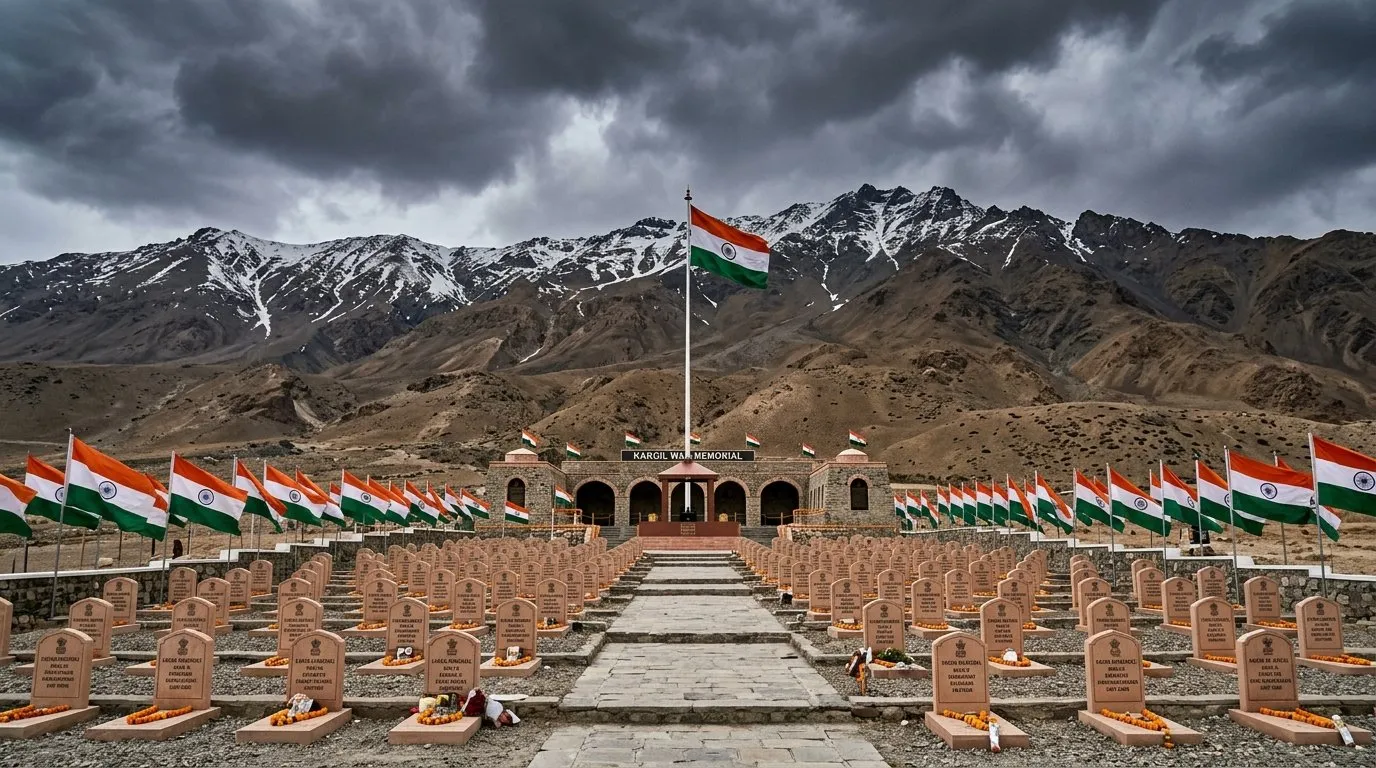
The real reason most people stop in Drass is the Kargil War Memorial. Located just outside town on the highway, the memorial honours the soldiers who died recapturing the peaks above Drass during the 1999 Kargil War. Tiger Hill and Tololing — names that dominated Indian news for weeks — are visible from the memorial grounds. Standing here, looking up at the peaks where soldiers fought at 5,000 metres in freezing conditions, delivers an emotional impact that no museum can replicate. This is not abstract history. The mountains are right there. The distances are real. The impossibility of what happened becomes physically tangible.
Drass is not a destination where you spend three days. It is a place where you stop for two or three hours, and those hours stay with you for years.
Best Month to Visit
June through September only. The Srinagar-Leh highway opens after Zoji La pass is cleared of snow, typically late May or early June. Drass sits 60 km east of Zoji La, so it is accessible as soon as the pass opens.
June is best — clear skies, manageable temperatures (5-20°C range), fewer tourists than July-August. The snow line is still low on surrounding peaks, which makes for dramatic scenery.
July-August brings warmer weather and occasional rain. The valley is at its greenest, which creates an almost surreal contrast with the war memorial's gravity.
September is risky. The pass can close early, and weather becomes unpredictable. Do not plan a September visit without backup plans.
Winter (November-April) is categorically off-limits for tourists. The road is closed, temperatures are lethal, and there is no tourism infrastructure operational.
How to Get There
Drass is on NH1 (Srinagar-Leh highway), approximately 145 km from Srinagar and 60 km west of Kargil.
From Srinagar: 5-7 hours by road. You will cross Zoji La pass (3,528m). Most travellers pass through Drass en route to Kargil and stop at the war memorial. Shared taxis and JKSRTC buses from Srinagar's Tourist Reception Centre pass through Drass. If you want to stop, hire a private vehicle — shared transport will not wait for you.
From Kargil: 60 km, approximately 1-1.5 hours. Easy day trip. Hire a taxi from Kargil (Rs 2,000-3,000 round trip).
From Leh: 280 km, 8-10 hours. Too far for a day trip. Visit Drass on your way between Leh and Srinagar.
There is no airport or railway anywhere near Drass. Nearest airport: Srinagar (145 km). Nearest railhead: Jammu Tawi (430 km).
What to Expect
Drass is tiny. A cluster of houses, a few shops, a mosque, and a military presence. The town itself takes ten minutes to walk through. Everything worth seeing is in the immediate vicinity.
Kargil War Memorial (Drass War Memorial): This is the primary draw. The memorial sits on the highway just east of town, maintained by the Indian Army. It includes a museum with photographs, equipment, and personal effects of fallen soldiers. The Sandstone Wall lists the names of every soldier killed during Operation Vijay. Outside, you can see the actual peaks — Tiger Hill, Tololing, Point 4875 — where the fighting took place. The army often has personnel available to explain the battle. No entry fee. Open daily during the tourist season. Allow 1.5-2 hours minimum.
Tiger Hill Viewpoint: Visible from the memorial but also accessible via a short drive to a closer viewpoint. The peak (Point 5062) was the most strategically important position captured by Pakistani forces and subsequently recaptured by the Indian Army. Seeing it from below puts the military achievement in physical perspective.
Drass Valley: If you have time, walk along the river. The valley floor is surprisingly lush in summer — small farms, wildflowers, and a silence broken only by water and wind. This is one of the few places in Ladakh that feels almost pastoral.
Mushkoh Valley: For the more adventurous, the Mushkoh Valley branches off near Drass and was another theatre of the 1999 war. Access requires permits and may be restricted. Check with the army or Kargil district administration.
Infrastructure Reality
Mobile: BSNL only. Jio and Airtel do not work in Drass. Buy a BSNL SIM before arriving if you need connectivity. Even BSNL is patchy outside the main settlement.
Internet: Essentially non-existent for tourists. Do not expect WiFi or data. Download everything you need before leaving Srinagar or Leh.
Medical: Nothing in Drass beyond a very basic health centre. The nearest hospital is Kargil District Hospital, 60 km east. For serious emergencies, evacuation to Srinagar is required. At 3,280m, altitude sickness is a real possibility if you have come directly from low elevation. Carry Diamox and watch for symptoms — headache, nausea, dizziness.
ATMs: No ATMs in Drass. Carry all cash you need from Srinagar or Kargil.
Fuel: There is a fuel station in Drass, but do not rely on it having stock. Fill up in Srinagar or Kargil.
Electricity: Unreliable. Power cuts are frequent. Charge all devices before arriving.
Where to Stay
Drass is not set up for overnight tourism. Most travellers visit as a stop between Srinagar and Kargil.
If you must stay: A handful of very basic guesthouses exist in Drass village. Expect minimal amenities — a bed, blankets, possibly a heater. Hot water is not guaranteed. Rates are Rs 500-1,500.
Better option: Stay in Kargil (60 km east) where accommodation is significantly better, and day-trip to Drass. The drive is easy and the road is good.
Camping: Wild camping is possible in the Drass valley during summer, but you need full self-sufficiency — tent, sleeping bag rated for below-zero nights (it drops to near 0°C even in July), cooking equipment, and food.
Kids Verdict: 1 out of 5
Drass is not suitable for young children. The drive from either direction is long and at altitude. The town has zero kid-friendly infrastructure — no restaurants, no parks, no activities. The war memorial content is emotionally heavy and not appropriate for very young children. The altitude (3,280m) poses a real health risk for small children who cannot articulate symptoms of altitude sickness.
Ages 0-8: Strongly not recommended.
Ages 9-12: Only if the child has a specific interest in military history and can handle the emotional weight.
Ages 13+: Teenagers studying Indian history will find the war memorial profoundly educational. The physical reality of standing beneath the peaks where soldiers fought is something no textbook can convey.
What to Avoid
Rushing through the war memorial. People stop, take a selfie with the sign, and leave in fifteen minutes. The museum and grounds deserve at least ninety minutes. Read the names on the wall. Look at the peaks. Listen to the army guide if one is available.
Visiting without warm clothing. Even in July, Drass mornings and evenings are cold — 5°C or below. Wind chill makes it worse. Carry a proper jacket.
Photography restrictions. The war memorial allows photography of the memorial itself, but do NOT photograph military installations, vehicles, or personnel positions visible from the area. The entire region is an active military zone.
Driving Zoji La in bad weather. If fog, rain, or snow has set in at the pass, wait. People die on Zoji La every year. It is not worth the risk.
Expecting facilities. There is no restaurant in Drass that would meet any urban standard. Eat before you come or carry food. The memorial has a small canteen that may or may not be operational.
The Bottom Line
Drass exists at the intersection of extreme geography and recent history. The often cited as the second coldest inhabited place on Earth is not a gimmick — the harshness of this environment is exactly what made the 1999 war so extraordinary and so costly. Visiting the war memorial beneath the actual peaks where soldiers fought and died is one of the most emotionally powerful experiences available to any traveller in India. You will not spend long in Drass. But the time you spend here has a weight that comfortable destinations cannot match. Build it into your Srinagar-Kargil-Leh itinerary as a mandatory stop, not an optional one.
Monthly Scores
| Destination | Jan | Feb | Mar | Apr | May | Jun | Jul | Aug | Sep | Oct | Nov | Dec |
|---|---|---|---|---|---|---|---|---|---|---|---|---|
| Drass | 2.0 | 2.0 | 2.0 | 2.0 | 6.0 | 8.0 | 8.0 | 8.0 | 8.0 | 4.0 | 2.0 | 2.0 |
The Window · Every Sunday
Liked this? Get one every Sunday.
Best score of the week, one honest skip, road updates. Four minutes. No spam.
More in Field guide
Is Manali safe for solo female travellers? Which Manali, and when
Manali is not one place. New Manali is a respectable hill town — 4/5 safe. Old Manali is the Himachal backpacker-cafe strip with party + drug scene — 2/5 after 10pm. McLeodganj 3 hours away holds 5/5 year-round. Pick deliberately.
5 min read
Solo-female travel in India — every destination scored, month by month
Most India travel guides tell women 'use common sense' and call it done. We rated 488 destinations on a 1-5 scale for solo-female safety, with month-specific overrides where it matters. Here's the methodology, the top 15, and the five that don't clear the bar.
10 min read
Is Kashmir safe for solo female travellers? What actually matters
Kashmir is the destination where the generic 'is India safe for women' post fails hardest. The answer depends on which month, which valley, which houseboat operator, and whether you're willing to dress differently than you would in Goa. Here's the concrete version.
6 min read- Emergency
- Army medical evacuation · Kargil District Hospital 60km
- Permit required
- See the process →
Go with confidence.