Complete Guide to Lolab Valley
Kashmir's hidden meadow valley — walnut trees, no tourists, and the silence that Gulmarg lost
Destinations in this article
State: Jammu & Kashmir | Elevation: 2,400m | Difficulty: Moderate
Why Go
Lolab Valley is 30 kilometres from Kupwara, accessible on a paved road, requires no permit for Indian tourists, and almost nobody visits. That last fact is the entire pitch.
While Gulmarg processes over a million visitors annually and Pahalgam creaks under 800,000+, Lolab Valley sits in its own quiet corner of north Kashmir with walnut orchards, apple trees, the Satbaran forest, and a gentle beauty that doesn't scream for attention. It's not dramatic — there are no 5,000-metre passes, no impossible blue lakes, no signboard records. It's just exceptionally, quietly beautiful. And empty.
Most Kashmiris haven't heard of Lolab Valley. Ask a taxi driver in Srinagar and you'll likely get a blank look or a vague "somewhere near Kupwara." This anonymity is both its problem and its preservation. No fame means no infrastructure development, but it also means no concrete hotels replacing orchards, no parking lots where meadows were, no chai stalls every 50 metres.
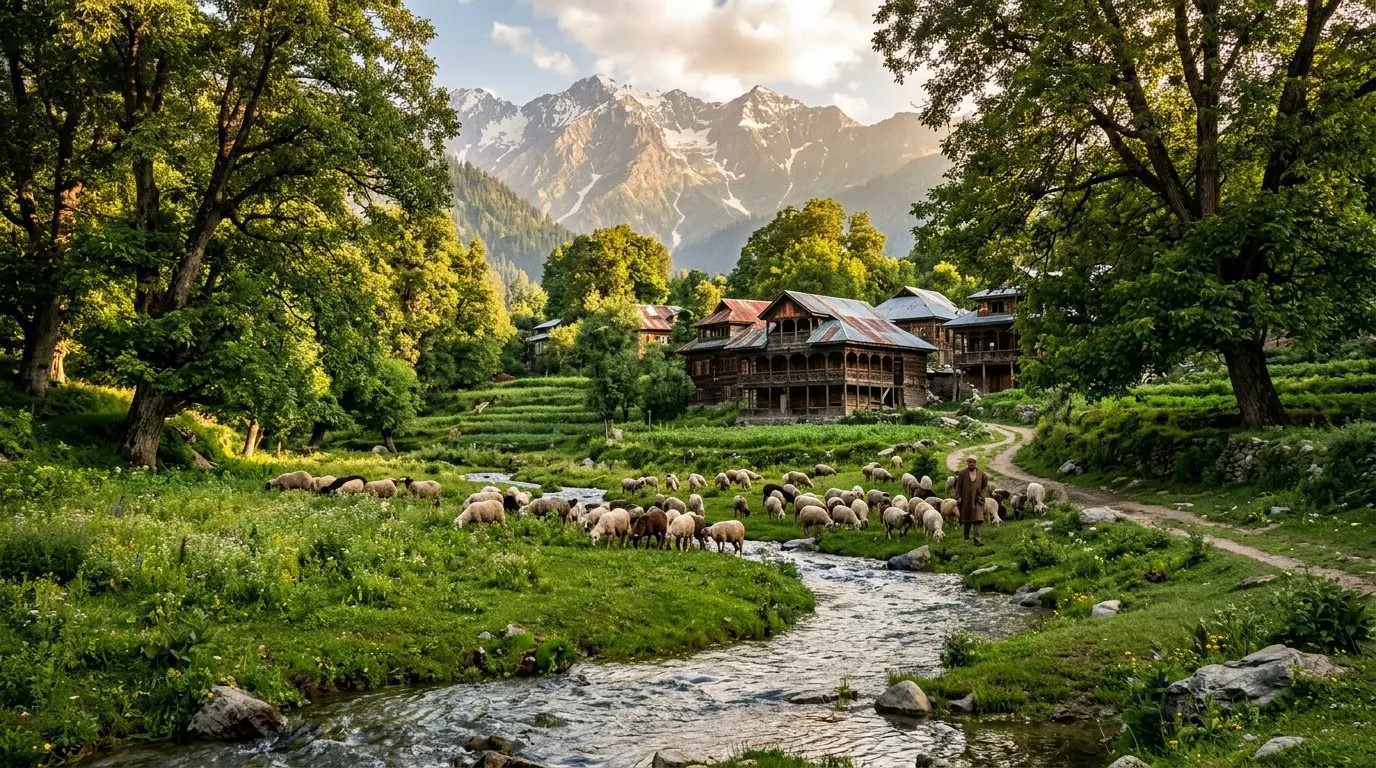
The valley runs roughly 25 km in length, flanked by moderate mountains (3,000-3,500m) covered in dense deodar, pine, and fir forest. The valley floor is a patchwork of paddy fields, walnut groves (some trees centuries old), and apple orchards. Small villages dot the landscape, their wooden houses and tin roofs fitting the terrain rather than fighting it.
The standout attractions are specific: Satbaran forest is a dense, ancient woodland that feels closer to European old-growth than typical Himalayan pine. Kalaroos Caves are a genuine archaeological curiosity — ancient caves with possible Buddhist-era connections, though academic research remains limited. And the overall landscape is the kind of gentle, pastoral beauty that rewards slow exploration rather than checkpoint tourism.
The Best Month (and the Worst)
Best: May to October. June and September are the sweet spots — pleasant temperatures (18-25°C), clear skies, orchards in full display.
Peak beauty: June (wildflowers, fresh green after snowmelt) and October (walnut harvest, autumn colours that rival anything in the Himalayas).
Good: July-August (warmer, occasional rain, but the valley stays green and lush). May (spring blooms, some higher areas still snowy).
Winter: November to March. Snow covers the valley, but unlike Bangus, the road to Kupwara stays open most of the winter. The valley itself becomes quieter than quiet — near-silent. Beautiful if you're equipped for cold (dropping to -5°C to -10°C at night), but accommodation options shrink to almost zero.
Rating: June: 5/5. September: 5/5. May and October: 4/5. July-August: 3/5 (rain). November-March: 2/5 (cold, limited facilities).
How to Get There
Route: Srinagar → Baramulla → Kupwara → Lolab Valley
Distances and times:
- ●Srinagar to Kupwara: 95 km, approximately 3 hours.
- ●Kupwara to Lolab Valley: 30 km, approximately 45 minutes to 1 hour on a paved road.
This is the critical difference between Lolab and Bangus. The road to Lolab is an actual road — paved, reasonably maintained, passable in a regular car. No 4x4 required. No permit required for Indian nationals (verify current status for foreign nationals with J&K tourism).
By public transport: Shared taxis and mini-buses run between Kupwara and Lolab villages. It's basic but functional. From Srinagar, regular buses and shared cabs go to Kupwara.
By private vehicle: Any car works. The drive from Srinagar is pleasant — through the Jhelum valley, past Baramulla, into the less-visited northern reaches of Kashmir.
No permit needed (for Indians). This is a significant advantage over Bangus Valley and many Ladakh destinations. You can decide to go in the morning and be there by afternoon.
What to Expect
Lolab Valley is not a destination that reveals itself through a single viewpoint or photo spot. It's a slow-burn experience — best appreciated over a full day of wandering.
Satbaran Forest: Dense, old-growth forest approximately 10 km into the valley. The trees are massive — deodar cedars with trunks wider than a car. The forest floor is carpeted in pine needles, dappled light filtering through. Walking trails exist but aren't formally marked. You won't need a guide — the forest is contained and the path intuitive.
Kalaroos Caves: A set of natural caves approximately 12 km from Kupwara, with historical significance that's still being researched. Local tradition connects them to Buddhist-era occupation, and some cave walls show what may be ancient markings. The caves are accessible via a short walk from the road. Don't expect interpretive signs or a visitor centre — there's a cave entrance and your own curiosity.
Walnut and apple orchards: In September-October, the walnut harvest transforms the valley. Families spread walnuts on rooftops to dry. The smell of fresh walnut husk is distinctive and memorable. Apple orchards are everywhere — Kashmiri apples from this region are considered among the best in India.
Villages: The settlements in Lolab are small, agricultural, and welcoming to the rare visitor. Tea will likely be offered. Accept it. Kashmiri hospitality in these less-visited areas is genuine and extraordinary — noon chai (pink salt tea) with fresh bread from a tandoor.
Mobile network: BSNL has patchy coverage in the valley. Jio and Airtel: unreliable to nonexistent. Don't count on data for navigation — download offline maps before leaving Srinagar.
Infrastructure Reality
Lolab Valley has more infrastructure than Bangus (which has zero) but less than any established Kashmir destination.
Accommodation: Very limited. A few basic guest houses in Lolab villages may accept tourists — ask locally. The JKTDC may have a rest house in the Kupwara area. Most visitors use Kupwara as a base and day-trip into Lolab.
Food: Small village shops stock basics — biscuits, chips, soft drinks. For meals, you're relying on village hospitality (often freely offered, but carry your own supplies as backup). There are basic restaurants in Kupwara town.
Medical: Kupwara District Hospital is 30 km away (45 minutes to 1 hour). Within the valley, there may be a primary health centre in larger villages, but don't count on it for anything beyond basic first aid.
ATM: No ATM in the valley. The nearest ATMs are in Kupwara town. Carry cash.
Electricity: Available in villages (state grid) but outages are common. Not relevant for day visitors, but matters if you're staying overnight.
Where to Stay
In Lolab Valley:
- ●Local guest houses: very basic, ₹500-1,000/night if available. Ask at village shops or chai stalls.
- ●Camping: possible with your own gear. The meadows and forest edges offer beautiful camping. Get permission from local village heads before pitching — people are generous but asking is respectful.
In Kupwara (recommended base):
- ●Basic hotels: ₹800-1,500/night. Clean rooms, basic facilities, Indian restaurants nearby.
- ●This is the practical choice — stay in Kupwara, drive to Lolab for the day, return in the evening.
In Srinagar (if day-tripping):
- ●It's possible but long — 3 hours each way plus time in the valley makes for a 10+ hour day. Better to overnight in Kupwara.
Kids Verdict
Rating: 2/5 — Possible but limited.
Lolab Valley is significantly more accessible than Bangus or Pangong, and the moderate elevation (2,400m) poses no altitude risk for children. The forest walks, the caves, and the village atmosphere can be engaging for curious kids.
However: the lack of structured activities, limited medical access (Kupwara hospital is 30 km away), basic food options, and zero entertainment infrastructure make it challenging for families with young children. Older children (10+) who enjoy nature and exploration will find it rewarding. Younger children will find it boring after an hour.
Best family approach: Day trip from Kupwara. Pack a picnic lunch. Walk through Satbaran forest. Visit the caves. Buy fresh walnuts or apples from a village. Return to Kupwara by evening.
What to Avoid
1. Comparing it to Gulmarg or Pahalgam. Lolab Valley is not a developed tourist destination. If you arrive expecting pony rides, gondola lifts, and restaurants, you'll be confused. This is rural Kashmir. That's the point.
2. Relying on mobile data for navigation. Download offline maps. BSNL is the only network with any coverage, and it's patchy.
3. Visiting without cash. No digital payments work here. Carry ₹2,000-3,000 minimum for the day.
4. Rushing through. This valley rewards slow exploration. If you drive through without stopping, you'll wonder what the fuss was about. Park the car. Walk into the forest. Sit under a walnut tree. Talk to a farmer. The valley reveals itself to people who stop.
5. Photographing people without permission. Kashmir's northern districts have security sensitivities. People may be uncomfortable being photographed. Always ask.
6. Littering. This applies everywhere but especially here. The valley is clean because it's unvisited. Keep it that way.
7. Expecting Kalaroos Caves to be a developed attraction. They're caves. In a hillside. With no signs, no guide, no ticket counter. Bring a torch.
The Bottom Line
Lolab Valley is Kashmir for people who found Kashmir. Not the postcard version — the real one. Walnut trees older than your grandparents. Forest that smells like it should. Villages where the arrival of a tourist is still an event worth mentioning over dinner.
It lacks the jaw-dropping drama of Pangong or the bragging rights of Umlingla. What it offers is rarer: a gentle, beautiful valley where you can spend a day walking, eating, and breathing without encountering another tourist, a queue, a ticket counter, or a selfie stick.
This is what "offbeat" actually means — not a slightly less crowded version of a famous place, but somewhere genuinely un-known.
Go if: You appreciate slow travel, you like forests and orchards more than passes and peaks, you're comfortable with zero infrastructure, and you want to see a side of Kashmir that 99.9% of tourists never reach.
Skip if: You need dramatic landscapes, structured activities, reliable connectivity, or Instagram-validated viewpoints.
Budget: ₹1,000-2,000/day including vehicle, food, and incidentals. One of the cheapest quality experiences in Kashmir. The walnut trees don't charge admission.
Monthly Scores
| Destination | Jan | Feb | Mar | Apr | May | Jun | Jul | Aug | Sep | Oct | Nov | Dec |
|---|---|---|---|---|---|---|---|---|---|---|---|---|
| Lolab Valley | 4.0 | 4.0 | 6.0 | 8.0 | 10.0 | 10.0 | 6.0 | 6.0 | 10.0 | 8.0 | 4.0 | 2.0 |
The Window · Every Sunday
Liked this? Get one every Sunday.
Best score of the week, one honest skip, road updates. Four minutes. No spam.
More in Field guide
Is Manali safe for solo female travellers? Which Manali, and when
Manali is not one place. New Manali is a respectable hill town — 4/5 safe. Old Manali is the Himachal backpacker-cafe strip with party + drug scene — 2/5 after 10pm. McLeodganj 3 hours away holds 5/5 year-round. Pick deliberately.
5 min read
Solo-female travel in India — every destination scored, month by month
Most India travel guides tell women 'use common sense' and call it done. We rated 488 destinations on a 1-5 scale for solo-female safety, with month-specific overrides where it matters. Here's the methodology, the top 15, and the five that don't clear the bar.
10 min read
Is Kashmir safe for solo female travellers? What actually matters
Kashmir is the destination where the generic 'is India safe for women' post fails hardest. The answer depends on which month, which valley, which houseboat operator, and whether you're willing to dress differently than you would in Goa. Here's the concrete version.
6 min read- Emergency
- 108 · District Hospital Kupwara (15km)
- Stay
- ₹500–2,500/night · 10 options
Go with confidence.