Complete Guide to Likir
A living monastery where monks still debate — plus a giant golden Buddha visible for miles
Destinations in this article
Why Go
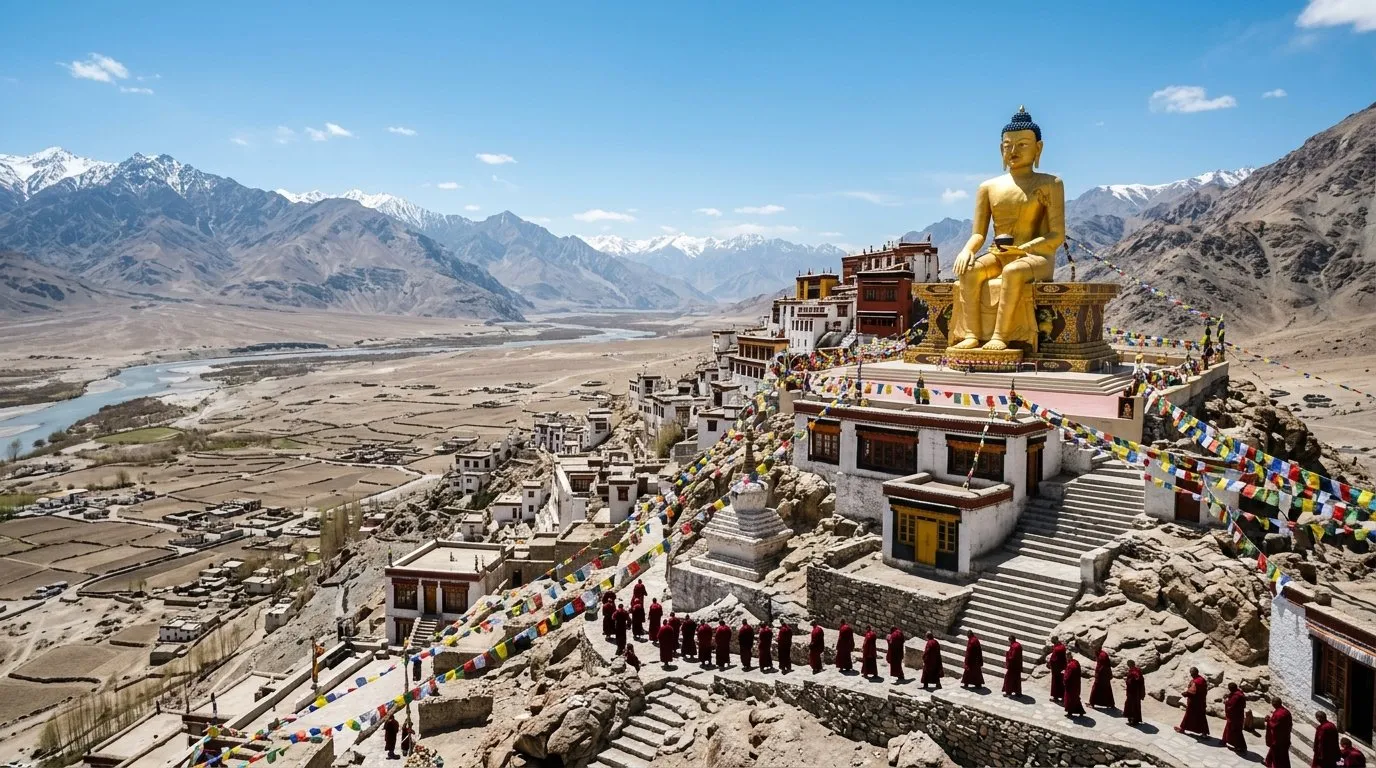
You see the Likir Monastery before you understand what you are looking at. Driving the side road from the Srinagar-Leh highway, a massive golden figure materialises on a hilltop — a 25-metre Maitreya Buddha, seated and gleaming against the brown mountains. It is visible from several kilometres away, and the scale only becomes more impressive as you get closer. This is not an ancient statue. It was installed in 1999. But it has become the defining image of Likir and one of the most recognisable landmarks in Ladakh.
The monastery below the statue is far older — originally founded in the 11th century and reorganized under the Gelugpa school in the 15th century and affiliated with the Gelugpa (Yellow Hat) school of Tibetan Buddhism, the same lineage as the Dalai Lama. Likir is a working monastery, not a museum. Around 120 monks live, study, and practice here, including young monks in the attached monastic school. Visit in the morning and you may hear chanting from the prayer halls. Visit during festival time and you will see cham dances performed with a fervour that reflects genuine belief, not tourist performance.
What sets Likir apart from the more famous monasteries closer to Leh (Hemis, Thiksey, Shey) is that it feels less visited and more alive. The monks are approachable and often happy to talk. The monastic school means children are everywhere — young boys in maroon robes playing between prayer sessions. The hilltop position offers panoramic views of the Indus Valley that rival any viewpoint in Ladakh. And the giant Maitreya Buddha provides the kind of visual anchor that makes a place unforgettable.
Likir also connects to Alchi via a walking trail (the Likir-Alchi trek, 1-2 days), making it a natural pairing for travellers interested in monastery culture.
Best Month to Visit
June through September for the best weather and full monastery activity.
June-July: The annual Likir Festival (Dosmochey) typically falls in winter (January-February), but the summer months are when the monastery is most accessible and the weather most comfortable. Daytime temperatures: 15-25°C. The surrounding landscape is brown and stark, which makes the golden Buddha even more striking against the sky.
August-September: Warmer days, cooling evenings. September light is particularly good for photography.
Winter (December-February): The Likir Festival (Dosmochey) takes place in winter, usually February. If you are in Leh during winter (flights operate year-round, though sometimes disrupted by weather), attending the festival is extraordinary. But expect cold — daytime temperatures around -5 to -10°C. The road from Leh to Likir is open year-round.
How to Get There
Likir is approximately 52 km west of Leh, accessed via a 9 km side road from the village of Saspol on NH1.
From Leh: 1.5-2 hours by road. The drive follows the Indus Valley on NH1 before turning off at Saspol. The side road to Likir is paved and in reasonable condition. Hire a private taxi from Leh (Rs 2,500-3,500 for a day trip) or combine with Alchi (30 km further west) for a full-day excursion.
From Alchi: 30 km, approximately 45 minutes. The two monasteries make a natural pair.
Shared transport: Limited. A local bus runs from Leh to Likir village, but frequency is low. Private taxi is the reliable option.
From Kargil: 170 km, 5-6 hours via NH1.
Nearest airport: Leh (52 km). No railway access.
What to Expect
The Giant Maitreya Buddha: The 25-metre gilded statue of Maitreya (the future Buddha) sits on a ridge above the monastery. Installed in 1999, it faces north toward the valley and is visible from the highway several kilometres away. You can walk right up to the base. The scale is genuinely impressive — this is one of the largest Buddha statues in Ladakh.
Main Monastery Complex: The monastery buildings cluster below the Maitreya statue on the hillside. The main assembly hall (Dukhang) contains old thangka paintings, Buddhist scriptures, and a collection of religious artefacts. The prayer halls have the smoky, butter-lamp atmosphere of an active religious institution. Monks are usually present and welcoming.
Monastic School: Likir's school educates young monks from across Ladakh. You may see boys studying, debating, or playing in the courtyards. The debates — where monks clap their hands and stamp their feet to make philosophical points — are a highlight if you happen to witness one. Do not interrupt or approach the school uninvited, but if monks invite you to watch, accept.
Museum: A small museum within the complex displays historical artefacts, old weapons, and religious items. Entry is usually free with a donation box.
Views: The hilltop position gives 360-degree views of the Indus Valley, surrounding mountains, and the road to Alchi. Sunset from the monastery is exceptional.
Likir-Alchi Trek: A 1-2 day walk connecting Likir to Alchi via the village of Yangthang. The trek crosses a pass at approximately 3,800m and offers solitude and valley views. Arrange through Leh trekking agencies or walk it independently with camping gear.
Infrastructure Reality
Mobile: BSNL only. Jio and Airtel do not work at Likir monastery, though Jio may have intermittent signal in the valley below. Prepare to be disconnected.
Internet: Not available at the monastery or village. Download offline maps and content before leaving Leh.
Medical: No medical facilities at Likir. The nearest hospital is in Leh, 52 km east (1.5-2 hours). Altitude is 3,700m — take this seriously. If you have not spent at least one night acclimatising in Leh, do not visit Likir. Carry Diamox and water.
ATMs: No ATMs. Cash only. Carry from Leh.
Fuel: No fuel station. Fill up in Leh.
Water: Carry your own. No reliable source at the monastery.
Where to Stay
Likir has very limited accommodation. Most visitors come as a day trip from Leh.
the monastery-run guesthouse: The monastery operates a basic guesthouse for visitors. Simple rooms, shared facilities. Rates: Rs 500-800. The experience of waking up at the monastery for morning prayers is unique and worth the simplicity.
Village Homestays: A few families in Likir village offer rooms. Basic but warm hospitality. Rs 800-1,200 including meals.
Day trip from Leh: The most practical option. Combine with Alchi for a full day: leave Leh early, visit Likir, drive to Alchi, return to Leh by evening.
Camping: Possible around the village with your own equipment. Nights are cold at 3,700m — bring a proper sleeping bag.
There are no hotels in Likir. If you want hotel accommodation, stay in Leh and day-trip.
Kids Verdict: 3 out of 5
The giant Maitreya Buddha is a genuine kid magnet — the scale impresses even toddlers. Young monks studying and playing around the monastery can be fascinating for children. The hilltop views are accessible (short climb from the parking area). The main drawback is altitude and the drive.
Ages 0-4: The Buddha statue will captivate them. But altitude risk at 3,700m is real. Keep the visit short if you bring young children.
Ages 5-10: Good age for this visit. The statue, the monks, the views, and the monastery's activity level all provide interest. Budget 1-1.5 hours.
Ages 11+: Old enough to engage with the Buddhist philosophy, the monastic education system, and the trekking options. If your teenager is curious, this is one of the more engaging monastery visits in Ladakh.
What to Avoid
Visiting without acclimatisation. At 3,700m, Likir is higher than Leh. If you have just arrived by flight, wait at least one full day before making this trip.
Skipping the walk to the Maitreya. Some visitors look at the statue from the parking area and leave. Walk up to the base. The scale only registers when you are standing next to it.
Disrupting the monks. This is a working monastery, not a tourist attraction. If monks are praying, debating, or studying, observe quietly. Ask before photographing people.
Visiting only Likir. The combination of Likir and Alchi gives you two contrasting monastery experiences — one medieval and art-focused, one living and devotional. Do both in a day.
Expecting facilities. There is no restaurant at the monastery. Carry snacks and water. A small shop in the village sells biscuits and drinks.
The Bottom Line
Likir delivers what many Ladakh monastery visits promise but do not always provide: a sense of encountering a living religious tradition rather than a historical monument. The 25-metre Maitreya Buddha is the visual hook that draws you in, but the working monastery below — with its chanting monks, debating students, and butter-lamp haze — is what makes the visit meaningful. Combine it with Alchi for a day that spans the full range of Ladakhi Buddhist culture, from 11th-century artistic masterpieces to 21st-century monastic education. And when the golden Buddha catches the afternoon light against a cloudless blue sky and brown mountains, you will understand why this image has become one of Ladakh's most iconic.
Monthly Scores
| Destination | Jan | Feb | Mar | Apr | May | Jun | Jul | Aug | Sep | Oct | Nov | Dec |
|---|---|---|---|---|---|---|---|---|---|---|---|---|
| Likir | 2.0 | 2.0 | 2.0 | 2.0 | 6.0 | 10.0 | 10.0 | 8.0 | 10.0 | 6.0 | 2.0 | 2.0 |
The Window · Every Sunday
Liked this? Get one every Sunday.
Best score of the week, one honest skip, road updates. Four minutes. No spam.
More in Field guide
Is Manali safe for solo female travellers? Which Manali, and when
Manali is not one place. New Manali is a respectable hill town — 4/5 safe. Old Manali is the Himachal backpacker-cafe strip with party + drug scene — 2/5 after 10pm. McLeodganj 3 hours away holds 5/5 year-round. Pick deliberately.
5 min read
Solo-female travel in India — every destination scored, month by month
Most India travel guides tell women 'use common sense' and call it done. We rated 488 destinations on a 1-5 scale for solo-female safety, with month-specific overrides where it matters. Here's the methodology, the top 15, and the five that don't clear the bar.
10 min read
Is Kashmir safe for solo female travellers? What actually matters
Kashmir is the destination where the generic 'is India safe for women' post fails hardest. The answer depends on which month, which valley, which houseboat operator, and whether you're willing to dress differently than you would in Goa. Here's the concrete version.
6 min read- Emergency
- 108 (limited) · PHC Saspol (20km), SNM Hospital Leh (52km)
- Stay
- ₹500–2,500/night · 8 options
- Permit required
- See the process →
Go with confidence.