Complete Guide to Landour
Ruskin Bond's village above Mussoorie — Char Dukan, Lal Tibba, and walks where nobody else walks
Destinations in this article
Why Go
Landour is the village above the hill station above the plains. Mussoorie — Uttarakhand's famous "Queen of the Hills" — sits at about 2,000 metres. Landour sits at 2,270 metres, directly above it, technically a separate cantonment area though functionally a continuation. The distinction matters because while Mussoorie has become a crowded tourist town with traffic jams, noise, and the same commercial strip you find at every Indian hill station, Landour has remained quiet. Vehicles are restricted. The roads are narrow, steep, and walkable. The pace is different.
Landour is famous for one resident: Ruskin Bond, India's most beloved English-language author, who has lived here since the 1960s. His books — "The Room on the Roof," "The Blue Umbrella," "A Flight of Pigeons" — are suffused with the landscapes, weather, and people of this specific hilltop. Bond can still be found at Cambridge Book Depot in Mussoorie's Mall Road on Saturday afternoons, signing books and chatting with visitors. Whether you are a Bond reader or not, his presence has given Landour a literary identity that shapes how people experience it.
Char Dukan — literally "four shops" — is Landour's most famous gathering point: a bend in the road with four small establishments selling tea, Maggi noodles, pancakes, and conversation. It is not a tourist attraction in any conventional sense. It is a place where people sit, eat, and watch the clouds move through the deodar trees. Its fame is entirely a function of its ordinariness.
Lal Tibba is Landour's highest point and the highest point in the Mussoorie-Landour area. On clear days, the view extends to the Himalayan range — Banderpunch, Swargarohini, and on exceptional days, distant peaks toward Gangotri. A telescope at the viewpoint helps identify specific mountains.
St Paul's Church, built in 1839, is a grey stone colonial structure with stained glass windows and a graveyard full of British-era headstones. The Landour Language School (now called the Landour Community Hospital campus) and other colonial buildings give the cantonment area an atmosphere that is more Shimla than Mussoorie — quieter, older, more settled.
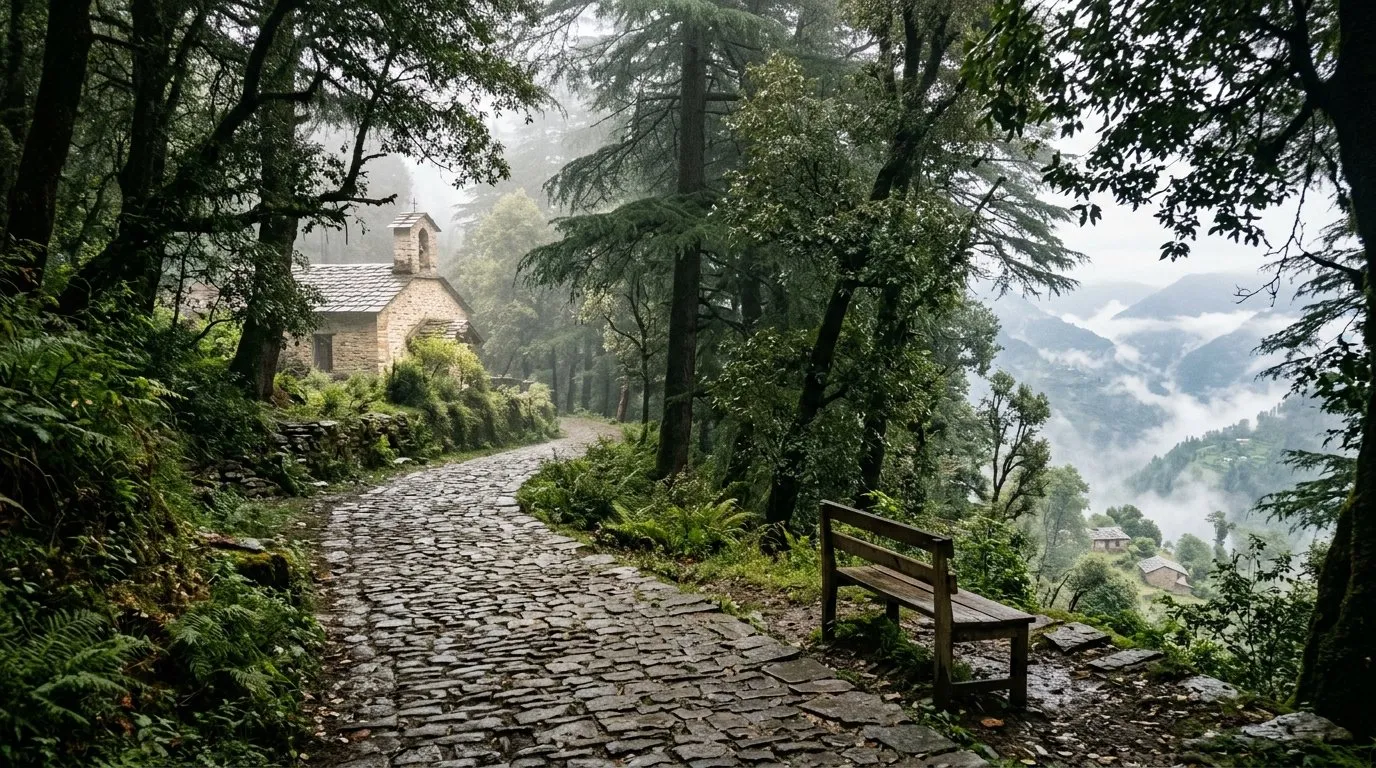
But the real reason to visit Landour is the walking. The network of paths — some paved, some dirt tracks, some barely visible — winds through deodar and oak forests, past old colonial houses, around the mountain, and to viewpoints that see almost no visitors. The Landour to Lal Tibba walk, the Sister's Bazaar loop, the path down to Woodstock School — these are walks where you hear birdsong instead of traffic, and where the views unfold gradually rather than appearing at a designated viewpoint.
Best Month to Visit
Landour has two prime windows. March through June is the first: the hills are green, wildflowers bloom, temperatures are pleasant (12-25°C), and the walking is at its best. April-May is the sweet spot — warm enough for comfortable outdoor activity, cool enough to escape the plains heat, and before the monsoon clouds move in. June gets increasingly cloudy as monsoon approaches.
September through November is the second window. Post-monsoon Landour is at its most beautiful: the air is washed clean, the forests are intensely green, and the mountain views are at their sharpest. October is exceptional — clear skies, comfortable temperatures (8-18°C), and few visitors. November gets cold but the clarity of winter light on the Himalayas compensates.
July-August is monsoon: heavy rain, leeches on trails, and clouds that obscure all views. Landour's charm is specifically visual and ambulatory — both of which are destroyed by monsoon. Avoid.
December-February is cold: temperatures drop to 0-5°C at night, occasional snowfall, and many establishments close or reduce hours. If you enjoy cold-weather walking and want maximum solitude, winter has its rewards. But carry serious warm gear and accept that some paths will be icy.
How to Get There
Landour is reached via Mussoorie. Mussoorie is 35 km from Dehradun (1-1.5 hours by road), and Dehradun is well-connected: the Jolly Grant airport has flights from Delhi and other cities, and Dehradun railway station has trains from Delhi (5-6 hours by Shatabdi), Kolkata, and other major cities.
From Mussoorie to Landour is about 4-5 km uphill. The road climbs steeply from the Mall Road area. Taxis and shared vehicles make the trip. If you are fit and carrying light luggage, the walk up is steep but enjoyable — about 45 minutes to an hour.
From Delhi by road, Mussoorie is about 280 km (6-7 hours). The drive via Dehradun is straightforward — mostly highway until the final hill climb from Dehradun to Mussoorie.
Within Landour, walking is the primary mode of transport. Vehicle access is limited — the roads are narrow and many are restricted to residents. This is by design and is fundamental to Landour's character. Bring walking shoes, not driving ambitions.
Infrastructure Reality
Landour's infrastructure is a step above remote hill villages but deliberately below full tourist development. There are several excellent small hotels and guesthouses — some in restored colonial buildings, some in newer constructions. Rokeby Manor and Landour Bakehouse (also a restaurant) are the best-known upscale options. Budget stays are available but less common than in Mussoorie proper.
Food is a genuine highlight. Landour Bakehouse produces excellent breads, pastries, and coffee. Char Dukan serves its famous pancakes and Maggi. Emily's restaurant (if still operating) offers proper meals. The food scene is small but quality-focused — a function of the literary and expat community that Landour attracts.
Mussoorie's full infrastructure — ATMs, hospitals, pharmacies, shops — is available 4-5 km downhill. Landour itself has limited shops and no ATMs. Carry cash for the small establishments.
Mobile coverage is good. Wi-Fi is available at most hotels. Electricity is reliable. Hot water works. The infrastructure is comfortable — you are not roughing it. You are simply in a small, quiet place that has chosen not to scale up.
Kids Verdict: 4 out of 5
Landour is one of the better hill station options for families. The walking paths are safe (no traffic), the terrain is manageable for children over 5, and the sensory experience — forests, birds, views, cool air — engages kids without requiring structured activities.
Char Dukan is child-friendly: the pancakes and Maggi are universally popular with Indian children, and sitting at an outdoor table watching monkeys in the trees is entertainment enough. The walks can be calibrated to children's stamina — short loops for younger kids, the full Lal Tibba circuit for older ones.
The Ruskin Bond connection works for families with readers. Bond's children's books are set in exactly this landscape — reading "The Cherry Tree" or "Rusty the Boy from the Hills" while sitting in Landour adds a dimension that children remember. If you time a Saturday afternoon visit to Cambridge Book Depot, meeting Bond himself is a possible highlight (but do not count on it — respect his routine and privacy).
The colonial churches and graveyards interest some older children. The Woodstock School campus (one of India's oldest international schools) is architecturally interesting from outside.
The main challenge is the steep terrain: pushchairs are useless, and very young children will need to be carried on some paths. The altitude (2,270 metres) is not a concern for healthy children but can cause mild breathlessness during steep walks. The lack of motorised transport within Landour means everything involves walking — fine for active families, challenging for those with mobility limitations.
The Bottom Line
Landour is the India that you find between the lines of a Ruskin Bond story: quiet, particular, and more interesting than it first appears. It is not a destination with a checklist — there is no monument to tick off, no activity to book, no experience to purchase. There is a hilltop, some old buildings, good paths, a bakery, four shops, and a view of the Himalayas.
Two nights is right. Arrive, walk to Char Dukan, eat pancakes, sleep. Next day, walk to Lal Tibba and back via the Sister's Bazaar route. Read a book on your hotel terrace. Visit Cambridge Book Depot in Mussoorie. Walk some more. Leave the next morning.
Landour offers something increasingly rare in Indian tourism: the chance to be somewhere without being processed by it. No entry tickets. No guides. No queues. No selfie points. Just a path, some trees, and the possibility that around the next bend, the clouds might part and show you the Himalayas.
That is either exactly what you want or it is not. Landour does not negotiate.
Monthly Scores
| Destination | Jan | Feb | Mar | Apr | May | Jun | Jul | Aug | Sep | Oct | Nov | Dec |
|---|---|---|---|---|---|---|---|---|---|---|---|---|
| Landour | 6.0 | 6.0 | 8.0 | 10.0 | 8.0 | 6.0 | 4.0 | 4.0 | 10.0 | 10.0 | 8.0 | 6.0 |
The Window · Every Sunday
Liked this? Get one every Sunday.
Best score of the week, one honest skip, road updates. Four minutes. No spam.
More in Field guide
Is Manali safe for solo female travellers? Which Manali, and when
Manali is not one place. New Manali is a respectable hill town — 4/5 safe. Old Manali is the Himachal backpacker-cafe strip with party + drug scene — 2/5 after 10pm. McLeodganj 3 hours away holds 5/5 year-round. Pick deliberately.
5 min read
Solo-female travel in India — every destination scored, month by month
Most India travel guides tell women 'use common sense' and call it done. We rated 488 destinations on a 1-5 scale for solo-female safety, with month-specific overrides where it matters. Here's the methodology, the top 15, and the five that don't clear the bar.
10 min read
Is Kashmir safe for solo female travellers? What actually matters
Kashmir is the destination where the generic 'is India safe for women' post fails hardest. The answer depends on which month, which valley, which houseboat operator, and whether you're willing to dress differently than you would in Goa. Here's the concrete version.
6 min read- Emergency
- 108 · Mussoorie Government Hospital (3km)
- Stay
- ₹2,000–15,000/night · 30 options
Go with confidence.