Complete Guide to Lahaul Valley
The valley beyond the Atal Tunnel — Keylong, Jispa, Darcha — where Himachal ends and Ladakh begins
Destinations in this article
Why Go
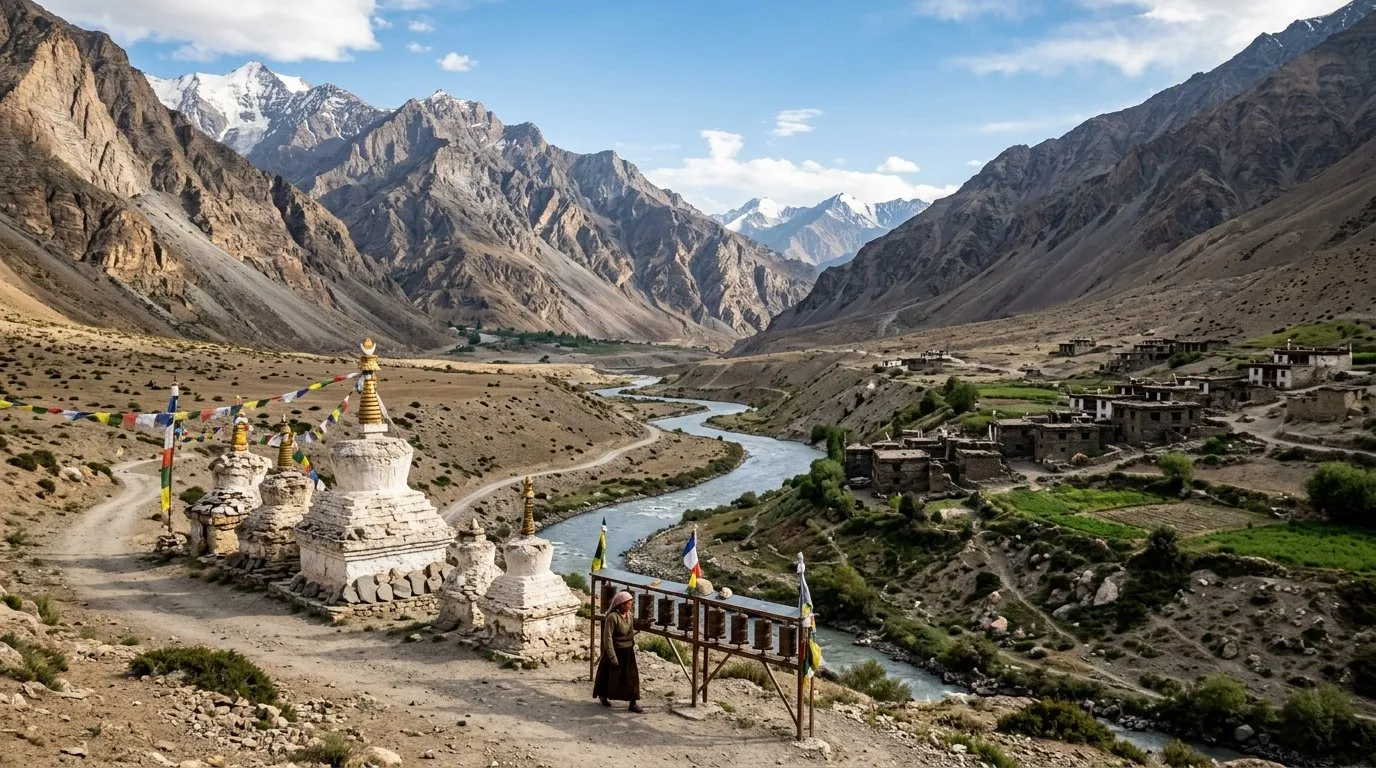
Lahaul Valley is what happens when you keep driving past the tourist boundary. Most visitors to Himachal Pradesh stop at Manali, maybe venture to Rohtang Pass for a snow selfie, and turn back. But push through the Atal Tunnel — or in the old days, over the Rohtang — and you enter a completely different Himachal. The Lahaul Valley is drier, higher, and emptier than anything south of the pass. Buddhism replaces Hinduism as the dominant visual culture. Apple orchards give way to willow-lined irrigation channels. The population thins to a whisper. And the landscape sharpens into something that feels more Central Asian than Indian.
The valley follows the Chandra and Bhaga rivers, which merge at Tandi to form the Chandrabhaga (known as the Chenab further downstream). Three towns anchor the valley: Keylong, the district headquarters with government offices, a hospital, and the valley's best infrastructure; Jispa, 20 km beyond Keylong, a riverside camping hub that has become the preferred overnight stop for Manali-Leh drivers; and Darcha, where the Manali-Leh highway begins its climb toward Baralacha La and the high passes that lead to Ladakh.
Before the Atal Tunnel opened in October 2020, Lahaul was cut off from the rest of India for six months every year when Rohtang Pass closed. That isolation shaped everything — the culture, the architecture, the self-sufficiency, and the quiet. The tunnel has changed the economics (year-round access, commercial connectivity) without yet changing the character. For now, Lahaul remains one of the most culturally distinct and least touristed valleys in the Indian Himalayas.
Shashur Monastery, Kardang Monastery, and Tayul Gompa are the valley's main Buddhist sites. The Chandratal Lake trek and the route over Kunzum La to Spiti are accessible from the valley. And the Manali-Leh highway — one of the world's great road trips — runs directly through it.
Best Month to Visit
May through October for the full valley. Year-round access to Keylong via the Atal Tunnel.
June: The valley comes alive after winter. Snow is melting, streams are full, and the first wildflowers appear. The Manali-Leh highway typically opens for through traffic by late June (BRO announces dates annually based on snow clearance at Baralacha La and beyond).
July-August: Warmest months (daytime 20-28°C in Keylong). The valley is green by Lahaul standards. Occasional monsoon moisture brings light rain but nothing like the deluge south of Rohtang. Best months for camping at Jispa and trekking.
September: The finest month. Clear skies, golden poplar trees, snow-dusted peaks, and the last of the summer warmth. Tourist numbers drop. Photography is exceptional.
October: The highway to Leh closes (usually mid-October). Keylong is still accessible via the tunnel. Temperatures drop. The valley empties.
November-April: Keylong is technically accessible year-round via the tunnel, but most hotels and restaurants close. Jispa and Darcha are snowbound and inaccessible. Only visit in winter if you have specific business or are equipped for extreme cold.
How to Get There
From Manali via Atal Tunnel: The primary route. Manali to Keylong is approximately 115 km, 3-4 hours. The tunnel eliminates the Rohtang Pass crossing. HRTC buses run daily. Private taxis charge Rs 3,000-5,000 one way to Keylong.
From Leh (Manali-Leh Highway): Approximately 470 km, typically a 2-day drive. Lahaul (Jispa/Keylong) is the final stage before Manali. Most Leh-to-Manali drivers spend their last night in Jispa or Keylong before the tunnel.
From Spiti via Kunzum La: Approximately 120 km from Kaza to Keylong via Kunzum La pass (4,590m). Road is rough and open only July-October. This connects the Spiti and Lahaul circuits.
Nearest Airport: Bhuntar (Kullu), 160 km south. Flights from Delhi and Chandigarh. Drive via Manali and tunnel.
Nearest Railway: Joginder Nagar (narrow gauge) or Chandigarh (broad gauge), both requiring 8-12 hours of onward road travel.
What to Expect
Keylong (3,080m): The district headquarters and largest town in Lahaul. Population approximately 2,500. Has a main bazaar, government offices, the district hospital, banks, and a modest selection of hotels and restaurants. Not a tourist destination in itself, but a functional base with the valley's best infrastructure. The Lahaul-Spiti District Tourism Office is here.
Shashur Monastery: Located 5 km from Keylong on a hillside, this 17th-century Drukpa Kagyu monastery offers views over the Bhaga Valley and houses a collection of painted scrolls and religious artefacts. The annual Shashur Festival (June-July) features masked cham dances. Less visited than the monastery circuit in Ladakh, which is precisely the appeal.
Kardang Monastery: Across the valley from Keylong, Kardang is a larger and older monastery (12th century) sitting above the village of the same name. The walk from Keylong to Kardang (6 km, crossing the Bhaga River) is one of the best short walks in the valley — valley views, terraced fields, and a monastery that sees almost no tourists.
Jispa (3,200m): Twenty kilometres beyond Keylong on the Manali-Leh highway, Jispa is a tiny settlement that has become the valley's most popular camping destination. The Bhaga River runs through a wide, flat valley floor that is perfect for riverside camps. Several operators run tented camps from June to September. Jispa is also the last comfortable overnight stop before the Manali-Leh highway climbs into serious high altitude — Baralacha La (4,890m) is 80 km north.
Darcha (3,360m): The last village on the Manali-Leh highway before the high passes. Darcha is a checkpoint — you register with the police here. Beyond Darcha, services end. The road climbs to Baralacha La and into Ladakh. Darcha is also the trailhead for treks to Zanskar (the Darcha-Padum route, 10-14 days, one of India's great wilderness treks).
Tayul Gompa: Near Keylong, this small gompa houses a remarkable 4-metre statue of Padmasambhava and ancient texts. Rarely visited but worth the detour.
Chandratal Connection: The route to Chandratal Lake (Moon Lake, 4,300m) branches off the highway between Sissu and Keylong. The lake is one of the most beautiful high-altitude lakes in India. Accessible by road (rough, 4WD recommended) or trek from Kunzum La. A full day trip from Keylong.
Infrastructure Reality
Mobile: BSNL is the most reliable network across the valley. Jio works in Keylong and Sissu but drops off elsewhere. Airtel is weak. Beyond Jispa, expect no coverage at all.
Internet: BSNL broadband and Jio 4G available in Keylong. Speeds are slow but functional for basic use. Jispa and Darcha: no reliable internet.
Medical: Keylong District Hospital is the valley's only proper medical facility. It handles basic emergencies and has a pharmacy. For anything serious — trauma, cardiac events, severe altitude sickness — evacuation to Manali or Chandigarh is required. The tunnel has dramatically reduced evacuation times (3-4 hours to Manali, versus 8+ hours over Rohtang).
ATMs: SBI ATM in Keylong. Often runs out of cash. Carry sufficient cash from Manali. No ATMs anywhere else in the valley.
Fuel: Petrol pumps at Tandi (between Sissu and Keylong). Fill up here if heading north toward Leh — the next fuel is in Karu (Ladakh), roughly 365 km away. This is the most critical fuelling point on the entire Manali-Leh highway.
Electricity: Available in Keylong and major villages but subject to outages. Jispa camps rely on generators or solar. Carry power banks.
Where to Stay
Keylong:
- ●Mid-range (Rs 2,000-4,000): Hotel Dekyid, Hotel Tashi Delek, and HPTDC Hotel Chandrabhaga Keylong are the better options. Clean rooms, hot water, restaurants serving north Indian and Lahauli food.
- ●Budget (Rs 800-1,500): Several guesthouses around the bazaar. Basic but functional.
Jispa:
- ●Camps (Rs 1,500-3,500): Multiple riverside camps operate June-September. Tented accommodation with cots, sleeping bags, and meal service. The setting — beside the Bhaga River with mountains on both sides — is spectacular. a vetted Keylong lodge (see Keylong stays) and Jispa Journeys are established operators.
- ●Hotels (Rs 1,500-3,000): A few basic hotels exist for those who prefer solid walls. Standards are modest.
Darcha: Almost nothing. A couple of tent dhabas operate during highway season. This is a stop for the self-sufficient.
Homestays: Increasingly available in Keylong and surrounding villages. Ask at the district tourism office or arrange through agencies in Manali.
Kids Verdict: 2 out of 5
Lahaul is a transit valley, not a kid-friendly destination. The drives are long, the altitude is high, and activities for children are limited. Older kids on a Manali-Leh road trip will find the landscape dramatic and the camping at Jispa enjoyable, but there is nothing specifically designed for children.
Ages 0-5: Not recommended. High altitude, long drives, limited medical facilities, basic food options.
Ages 6-10: Manageable for one night in Keylong or Jispa as part of a larger trip. The riverside camping at Jispa is the most kid-friendly activity. Bring entertainment for the drives.
Ages 11+: Teenagers on a Manali-Leh road trip will appreciate the landscape transition and the camping. The monasteries provide cultural interest. The Chandratal trek is suitable for fit older teenagers.
What to Avoid
Underestimating distances. The valley feels compact on a map but drives take longer than expected — mountain roads, military convoys, occasional landslides. Keylong to Jispa is 20 km but allow 40 minutes. Keylong to Darcha is 50 km but allow 1.5 hours.
Skipping fuel at Tandi. If you are heading toward Leh, this is your last fuel for 365 km. Run out of fuel north of Darcha and you are in serious trouble. Fill the tank completely and carry a jerry can.
Attempting Baralacha La without acclimatisation. The pass is at 4,890m. If you have come from Manali (2,050m) via the tunnel and driven straight to Darcha, your body has not adjusted. Spend at least one night in the valley before climbing higher.
Assuming year-round access to Jispa and Darcha. The tunnel reaches Keylong, but the road beyond Keylong to Jispa and Darcha is not tunnel-protected. Winter snow closes this stretch. Keylong itself is accessible year-round.
Ignoring weather forecasts. Landslides are common in July-August, particularly between Sissu and Keylong. Check road status with BRO (Border Roads Organisation) before travelling. Their helpline and social media accounts provide updates.
Treating it as just a highway. Most Manali-Leh travellers blast through Lahaul in a few hours. Spending a day exploring Keylong, Shashur, and Kardang reveals a valley with its own distinct culture that is neither Kullu nor Ladakh.
The Bottom Line
Lahaul Valley is the transition zone — geographically, culturally, and psychologically — between the familiar Indian Himalayas and the alien landscapes of Ladakh. The Atal Tunnel has made this transition accessible year-round, but the valley itself retains the quiet, austere beauty of a place that was cut off from India for half of every year for most of its history. Keylong is functional and grounded. Jispa is one of the most beautiful camping spots on the Manali-Leh route. Darcha is where comfort ends and adventure begins. The monasteries — Shashur, Kardang, Tayul — offer Buddhist culture without Ladakh's tourist infrastructure and crowds. Whether you are passing through on the way to Leh or deliberately pausing to explore, Lahaul rewards attention. The valley is the gateway, but it is also a destination in its own right — one that most travellers overlook because the road keeps going north. Stop. Look around. The mountains here are not waiting for your attention, but they deserve it.
Monthly Scores
| Destination | Jan | Feb | Mar | Apr | May | Jun | Jul | Aug | Sep | Oct | Nov | Dec |
|---|---|---|---|---|---|---|---|---|---|---|---|---|
| Keylong | 4.0 | 4.0 | 4.0 | 6.0 | 8.0 | 10.0 | 10.0 | 10.0 | 10.0 | 8.0 | 4.0 | 4.0 |
| Lahaul Valley | 2.0 | 2.0 | 2.0 | 4.0 | 8.0 | 10.0 | 8.0 | 6.0 | 10.0 | 8.0 | 4.0 | 2.0 |
The Window · Every Sunday
Liked this? Get one every Sunday.
Best score of the week, one honest skip, road updates. Four minutes. No spam.
More in Field guide
Is Manali safe for solo female travellers? Which Manali, and when
Manali is not one place. New Manali is a respectable hill town — 4/5 safe. Old Manali is the Himachal backpacker-cafe strip with party + drug scene — 2/5 after 10pm. McLeodganj 3 hours away holds 5/5 year-round. Pick deliberately.
5 min read
Solo-female travel in India — every destination scored, month by month
Most India travel guides tell women 'use common sense' and call it done. We rated 488 destinations on a 1-5 scale for solo-female safety, with month-specific overrides where it matters. Here's the methodology, the top 15, and the five that don't clear the bar.
10 min read
Is Kashmir safe for solo female travellers? What actually matters
Kashmir is the destination where the generic 'is India safe for women' post fails hardest. The answer depends on which month, which valley, which houseboat operator, and whether you're willing to dress differently than you would in Goa. Here's the concrete version.
6 min read- Access
- Atal Tunnel has improved access. Beyond Keylong roads rough. Closed in heavy snow.
- Emergency
- 108 (unreliable, long response) · District Hospital Keylong — basic. Serious cases evacuated to Manali.
- Stay
- ₹500-3000/night · 20 options
Go with confidence.