Complete Guide to Kargil
The gateway between Kashmir and Ladakh — war history, Zanskar road, and a town finding peace
Destinations in this article
Why Go
Kargil is one of those places most Indians know by name but almost nobody visits on purpose. That is a mistake. Sitting at 2,676 metres in the Suru Valley, wedged between the Kashmir Valley to the west and Ladakh's high plateau to the east, Kargil is a town that has spent decades defined by a war fought on its doorstep. But there is far more here than conflict history. This is the gateway to Zanskar — one of the most remote inhabited valleys on Earth. It is where the lush green of Kashmir starts giving way to the stark brown of Ladakh. And it is a place where Balti culture, Shia Muslim traditions, and Ladakhi Buddhist heritage overlap in ways you will not find anywhere else in India.
The Kargil War of 1999 put this town on every Indian's mental map, and the war memorial and surrounding peaks remain powerful draws. But the town itself is a working district headquarters with bazaars, mosques, and a pace of life that has nothing to do with tourism. That rawness is exactly the point. You are not visiting a vetted experience. You are passing through a real place on one of Asia's great road journeys.
For travellers driving the Srinagar-Leh highway, Kargil is the mandatory overnight halt — the road splits here, and the distances in either direction demand a break. But if you treat it as just a pit stop, you will miss what makes this stretch of Ladakh genuinely different from the monastery-and-lake circuit further east.
Best Month to Visit
June through September is your window. The Srinagar-Leh highway (NH1) typically opens in late May or early June, depending on snow clearance at Zoji La pass (3,528m). September is the tail end — the pass can close as early as mid-October, sometimes earlier after heavy snowfall.
July and August offer the warmest weather (daytime highs around 25-30°C), but also bring occasional rain from the tail end of the monsoon that sneaks over Zoji La. The Suru Valley turns genuinely green during these months, which creates a landscape completely unlike the brown aridity most people associate with Ladakh.
June is ideal if you want clear skies and manageable temperatures without peak-season crowds. September gives you autumn colours in the poplar-lined valleys but carries the risk of early closure.
If you are heading to Zanskar from Kargil, July and August are the only reliable months — the road to Padum is rough and snow-dependent.
How to Get There
By Road from Srinagar: The classic approach. NH1 from Srinagar to Kargil is approximately 205 km and takes 8-10 hours depending on conditions at Zoji La. The road is two-lane, partially paved, partially disaster. You will cross Zoji La at 3,528m — expect military convoys, possible delays, and one of the most dramatic transitions in Indian geography. Shared taxis and JKSRTC buses run daily from Srinagar's Tourist Reception Centre. Budget around Rs 700-1,200 for a shared taxi seat.
By Road from Leh: Approximately 220 km via Lamayuru and Mulbekh on NH1. Takes 6-8 hours. This stretch is generally better maintained than the Srinagar side. Shared taxis available from Leh bus stand.
By Air: Kargil has no airport. The nearest airports are Srinagar (Sheikh ul-Alam International, 205 km) and Kushok Bakula Rimpochee Airport in Leh (220 km). Both have daily flights from Delhi. From either airport, you are looking at a full day's drive.
There is no railway anywhere close. The nearest railhead is Jammu Tawi, roughly 470 km and a brutal two-day drive via Srinagar.
What to Expect
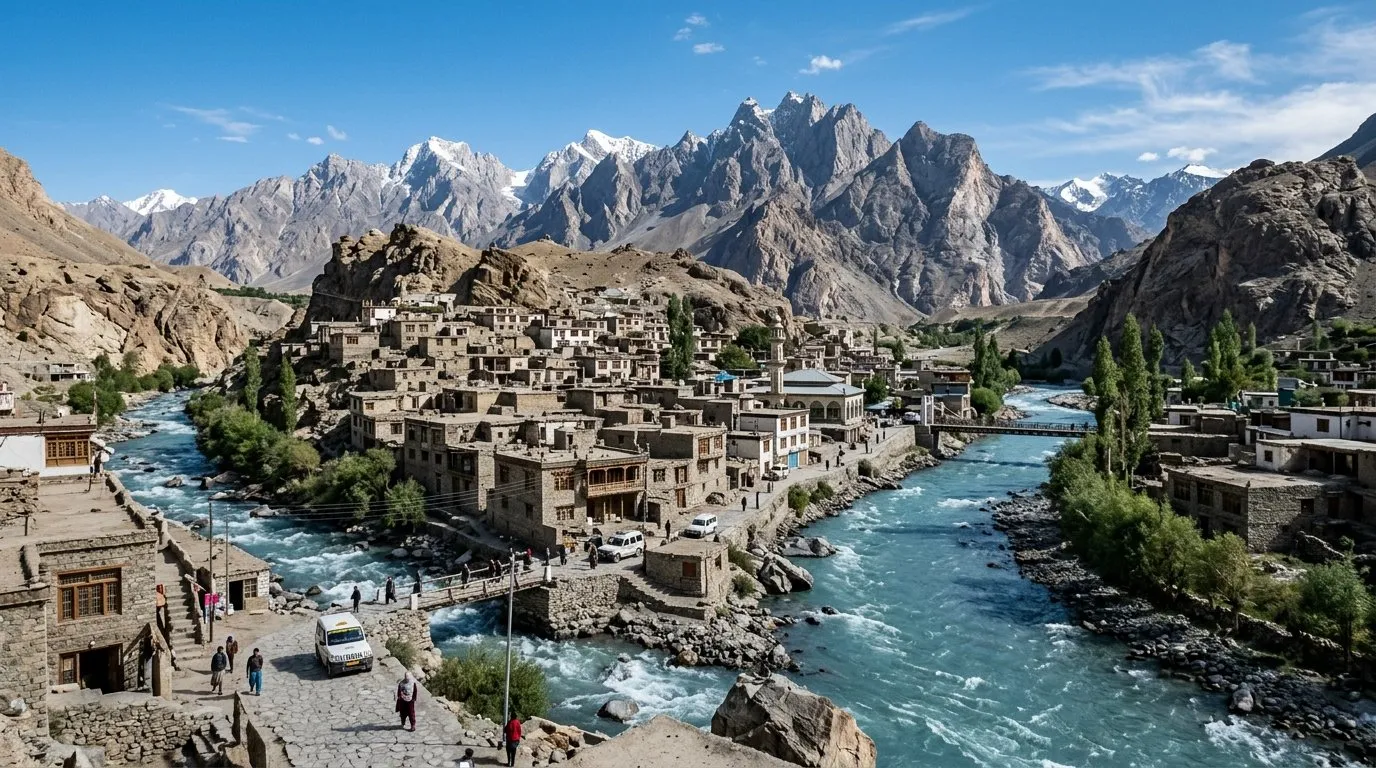
Kargil town itself is not beautiful in the conventional sense. It is a utilitarian district headquarters built along the Suru River, with a main bazaar, government offices, and a collection of hotels ranging from basic to acceptable. The beauty is in the setting — mountains rise on every side, the river cuts through the valley floor, and the transition between green Kashmir and brown Ladakh is visible in real time.
Kargil War Memorial (Dras sector): The main war memorial is actually in Drass, 60 km west (see separate guide). But the Kargil region is dotted with viewpoints and positions from the 1999 conflict. The town itself has a small war museum worth an hour.
Suru Valley: South of Kargil, the Suru Valley runs toward the twin peaks of Nun and Kun (7,135m and 7,077m — Ladakh's highest). The valley is green, farmed, and strikingly different from everything east of here. Villages like Sankoo and Panikhar are worth a day trip.
Gateway to Zanskar: The road from Kargil to Padum (240 km) is one of India's great adventure routes. It crosses Pensi La (4,400m) and drops into the Zanskar Valley, which remains one of the most isolated inhabited regions in Asia. This is a 10-12 hour drive in good conditions, but conditions are rarely good.
Munshi Aziz Bhat Museum of Central Asian and Kargil Trade Artefacts: A small but fascinating private museum documenting Kargil's historic role as a trading post on the route between Kashmir, Ladakh, and Central Asia.
Infrastructure Reality
Mobile: Jio and Airtel both work in Kargil town. BSNL has the widest coverage in surrounding areas. Once you head toward Zanskar, expect coverage to drop to zero within 30 km of town. Download offline maps before you leave.
Internet: Most hotels offer WiFi, but speeds are modest — enough for WhatsApp, not enough for video calls. 4G works in town on Jio and Airtel.
Medical: Kargil District Hospital is the primary facility. It handles basic emergencies but for anything serious, evacuation to Srinagar or Leh is necessary. There are pharmacies in the main bazaar. Bring altitude sickness medication (Diamox) as a precaution — at 2,676m, most people adjust fine, but if you are coming directly from sea level, give yourself a day.
ATMs: SBI and J&K Bank ATMs are available in Kargil town. They run out of cash occasionally. Carry sufficient cash if heading toward Zanskar.
Fuel: Petrol pumps in Kargil town. Fill up completely if heading to Zanskar — there is nothing until Padum.
Electricity: Generally reliable in Kargil town with occasional outages. Hotels usually have backup.
Where to Stay
Kargil is not a luxury destination. Expect clean but basic accommodation.
Mid-range (Rs 2,000-4,000): Hotel D'Zojila, a vetted mid-tier Kargil hotel, and one of the named Kargil hotels are the better options in town. Rooms are clean, hot water is available (usually solar-heated), and restaurants serve decent Kashmiri and Ladakhi food. Book ahead in July-August.
Budget (Rs 800-1,500): Several guesthouses along the main bazaar. Standards vary. Check the room before committing.
Homestays: Increasingly available in Suru Valley villages. This is the best way to experience Balti culture and home-cooked food. Ask at the Kargil tourist office or arrange through travel agencies in Leh.
There are no luxury hotels. If you need high-end accommodation, Kargil is not your destination.
Kids Verdict: 2 out of 5
Kargil is not a great choice for young children. The road in from either direction is long, rough, and at altitude. The town itself has limited kid-friendly activities. The war history is heavy. That said, older teenagers with an interest in history or adventure travel may find it fascinating. The Suru Valley is gentler and more manageable for families, but infrastructure remains basic.
Ages 0-5: Not recommended. Long drives, altitude, limited medical facilities.
Ages 6-12: Possible but challenging. The drives will test patience.
Ages 13+: Suitable for teens interested in history, geography, or adventure. The Zanskar road is a genuine wilderness experience.
What to Avoid
Treating it as just a pit stop. Give Kargil at least two nights if you can. One night means you see nothing but your hotel room.
Driving Zoji La at night. The pass is dangerous in daylight. At night it is genuinely reckless. Time your arrival from Srinagar to cross the pass in morning hours.
Assuming Zanskar is a casual day trip. The road to Padum is a serious undertaking. Budget at least 3-4 days for a round trip, more if you want to actually see anything.
Photographing military installations. The region is heavily militarised. Pointing cameras at army camps, bunkers, or checkpoints will get your camera confiscated and you detained. Stick to the scenery.
Ignoring local customs. Kargil is predominantly Shia Muslim. Dress modestly, especially women. During Muharram (dates vary), be respectful of religious processions.
The Bottom Line
Kargil is not a destination you visit for comfort or Instagram content. It is a place you visit because it sits at one of the great geographic and cultural crossroads of the subcontinent — where Kashmir becomes Ladakh, where Islam meets Buddhism, where green valleys give way to brown moonscape. The war history adds a layer of gravity that makes everything feel more significant. If you are driving the Srinagar-Leh highway, giving Kargil an extra day transforms it from a forgettable overnight halt into one of the most memorable stops on the entire route. And if Zanskar is on your list, Kargil is where the real adventure begins.
Monthly Scores
| Destination | Jan | Feb | Mar | Apr | May | Jun | Jul | Aug | Sep | Oct | Nov | Dec |
|---|---|---|---|---|---|---|---|---|---|---|---|---|
| Kargil | 2.0 | 2.0 | 2.0 | 4.0 | 6.0 | 10.0 | 10.0 | 8.0 | 10.0 | 6.0 | 2.0 | 2.0 |
The Window · Every Sunday
Liked this? Get one every Sunday.
Best score of the week, one honest skip, road updates. Four minutes. No spam.
More in Field guide
Is Manali safe for solo female travellers? Which Manali, and when
Manali is not one place. New Manali is a respectable hill town — 4/5 safe. Old Manali is the Himachal backpacker-cafe strip with party + drug scene — 2/5 after 10pm. McLeodganj 3 hours away holds 5/5 year-round. Pick deliberately.
5 min read
Solo-female travel in India — every destination scored, month by month
Most India travel guides tell women 'use common sense' and call it done. We rated 488 destinations on a 1-5 scale for solo-female safety, with month-specific overrides where it matters. Here's the methodology, the top 15, and the five that don't clear the bar.
10 min read
Is Kashmir safe for solo female travellers? What actually matters
Kashmir is the destination where the generic 'is India safe for women' post fails hardest. The answer depends on which month, which valley, which houseboat operator, and whether you're willing to dress differently than you would in Goa. Here's the concrete version.
6 min read- Emergency
- 108 · Kargil District Hospital
- Permit required
- See the process →
Go with confidence.