Hanle Dark Sky Spot.
Observatory restricted. The stargazing plateau 2km away is not marked.WHY NOBODY KNOWS
One of world best naked-eye astronomy sites. Milky Way core visible without equipment at 4500m.
DISPATCH · ISSUE Nº 47
Darkest skies in India — a remote observatory village at 4500m where the Milky Way is visible to the naked eye.
VERIFIED APR 2026 · ISSUE Nº 47
5 MIN READ·Or skip to the verdict ↓
“Darkest skies in India — a remote observatory village at 4500m where the Milky Way is visible to the naked eye.”
WHY SPECIAL
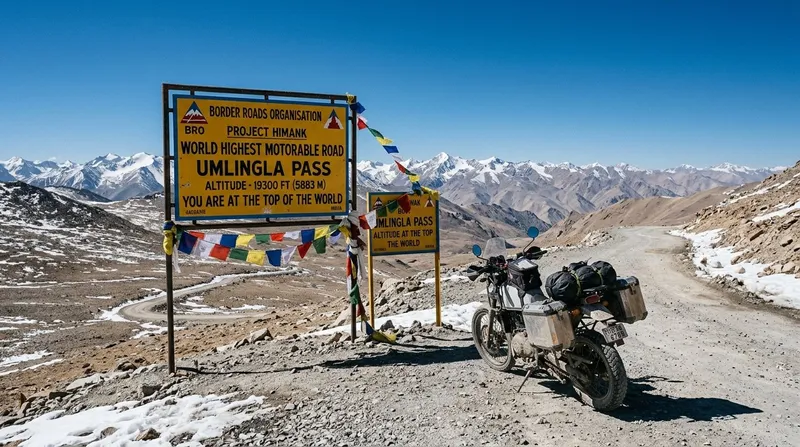
Hanle has the Indian Astronomical Observatory — placed here because it has the lowest light pollution and driest air in India. Beyond Hanle, Umlingla Pass (5798m, 19024ft) is the highest motorable road in the world, opened by BRO in 2021.
Know before you go
Every month rated on the 0–10 editorial scale. Click any cell to read the month-specific verdict — what to do, what to skip, what crowds you'll meet.
↑ Tap any month for the full read · colours match verdict bands
Read our scoring methodology →
ELEVATION
Hanle has the Indian Astronomical Observatory — placed here because it has the lowest light pollution and driest air in India. Beyond Hanle, Umlingla Pass (5798m, 19024ft) is the highest motorable road in the world, opened by BRO in 2021.
If
You develop a mild headache, nausea, dizziness or loss of appetite above roughly 2,500m within 6–24 hours of arrival.
Then
Stop ascending. Rest at the current altitude for 24–48 hours. Hydrate aggressively. If symptoms worsen or fail to improve, descend 500m and seek medical help. Never ascend further while symptomatic — HAPE and HACE kill quietly.
Full protocol →
If
Your UPI apps return Server Error or Bank Unavailable repeatedly, and no card reader is in sight.
Then
This is the default state in most border valleys, not an emergency. Carry at least ₹10,000 cash in mixed denominations for any trip above 2,500m or off a state highway. Withdraw at the LAST reliable ATM — usually the district HQ — because village ATMs are ornamental.
Full protocol →
Every destination carries trade-offs. The cards below score the practical ones: confidence in the data, kids-suitability, solo-female read, and the emergency floor.
Leh→Hanle: 260km 8-10hrs.
Road: Poor to fair. Unpaved. BRO maintains but conditions vary.
Public transport: None. Must hire vehicle from Leh.
Self-drive: 4x4 mandatory. Highest motorable roads in world. Umlingla at 5883m.
5 options (homestay, guest tent)
₹500-1500/night
Phone or walk-in only.
Emergency: Homestays will accommodate.
Nearest: None. Carry fuel from Leh or Nyoma (150km).
Next: Leh 260km
⚠ Carry extra fuel
EV charging: Not available
Extreme cold year-round. Summer days warm but nights freezing. Winter uninhabitable for tourists.
Hospital: Army medical post. Nearest hospital Leh 260km.
Police: Army/ITBP checkpost
Rescue: Army, ITBP
Ambulance: None
Helpline: DC Leh: 01982-252010
WiFi: None
BSNL only, very weak. Satellite phone strongly recommended. No data.
KIDS · FAMILY READ
CONCERNS
Extreme altitude (4500-5798m). Zero facilities. 250km from nearest hospital. This is for experienced, fit adults only.
Ladakh's dark-sky + astronomical observatory town — remote, permit-restricted, astronomer-tourist flow. Organised group (Dhanyal Hanle) only.
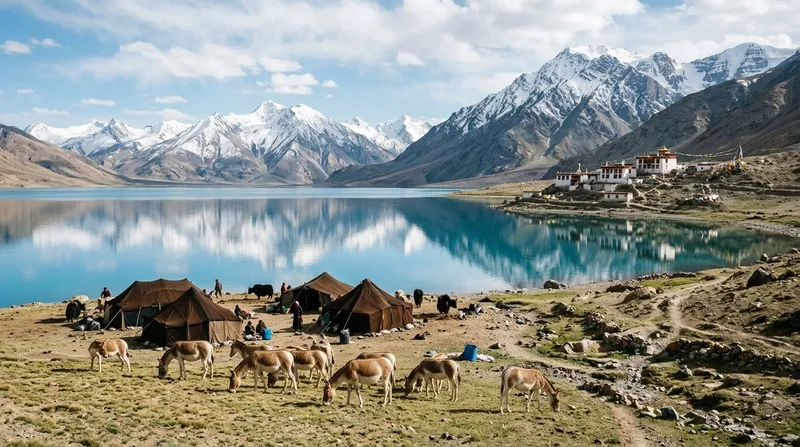
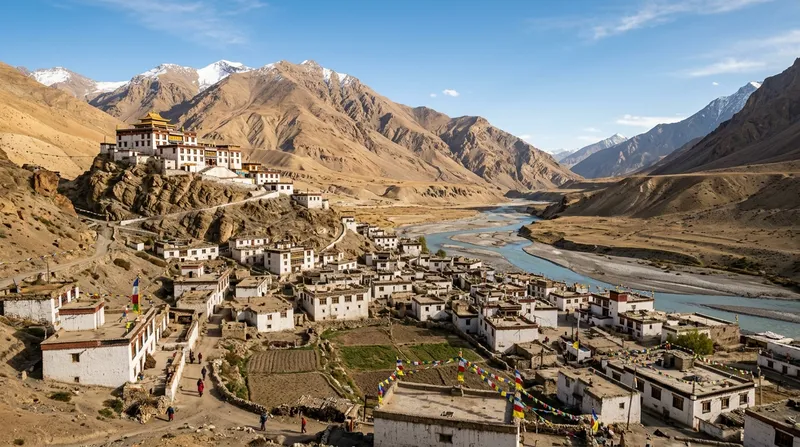
Hanle is one of the most remote inhabited places in India — home to a 17th-century monastery and the Indian Astronomical Observatory (one of the world's highest optical telescopes at 4500m). Changthang plateau, near the Chinese border. Extraordinary stargazing.
Warm layers essential year-round. Respectful dress at Hanle Monastery — remove shoes, walk clockwise. UV protection critical at this altitude.
Extremely limited — homestays provide basic meals. Carry all supplies from Leh (250 km). Water purification tablets recommended. No restaurants.
None — too remote.
Cash only. No ATMs within 200+ km. Carry all cash from Leh.
Very low. Changpa nomadic herders speak Ladakhi. Homestay hosts may speak basic Hindi.
BSNL postpaid only — extremely unreliable. Essentially no mobile connectivity. Satellite phone recommended for emergencies. Download all maps offline.
Delhi — over 1200 km. Nearest medical: Leh Army Hospital (250 km). Carry a comprehensive first aid kit. AMS (Acute Mountain Sickness) is a serious risk at 4500m.
Inner Line Permit (ILP) required — obtain in Leh DC office. Foreign nationals need additional Protected Area Permit (PAP). Processing takes 1-2 days. Carry multiple passport copies.
EMERGENCY · SOURCE-VERIFIED
Remote 17th-century Drukpa Kagyu monastery on a hillock overlooking the Hanle plains and observatory.
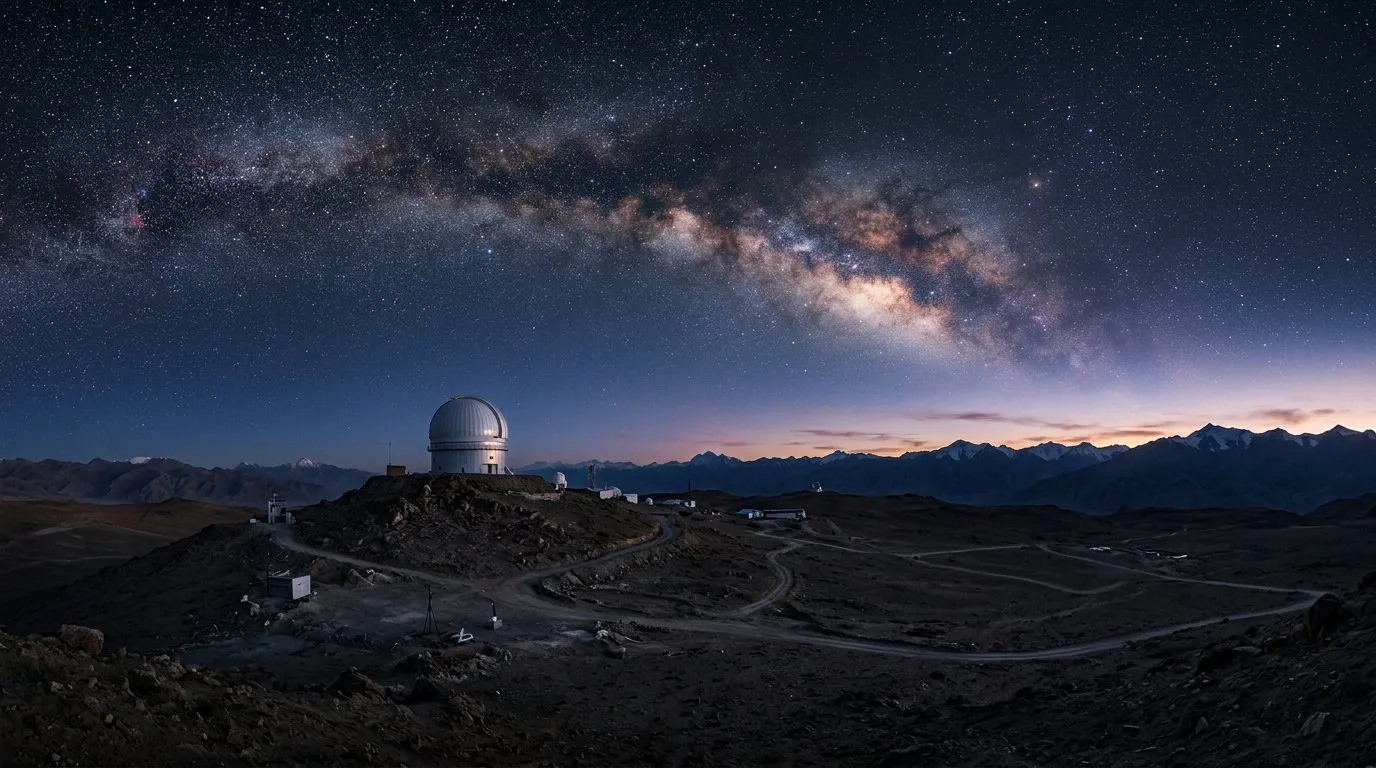
One of the world's highest optical observatories at 14,764 ft. Night sky among the clearest on Earth.
HIDDEN GEMS · 3 NEAR HANLE
Observatory restricted. The stargazing plateau 2km away is not marked.WHY NOBODY KNOWS
One of world best naked-eye astronomy sites. Milky Way core visible without equipment at 4500m.
Bortle Class 1-2 sky (the darkest possible on the 9-point scale) means the Milky Way casts a visible shadow on clear nights — a phenomenon impossible at 99.9% of Indian locations. Six Hanle hamlets fall inside the reserve and ~30 trained "Astronomy Ambassadors" (locals trained by IIA) host stargazing sessions using 24 personal telescopes distributed by the observatory program. White-light curfew applies after 10pm — homestays use red-tinted lamps. Best Apr-Oct (Nov-Mar accessible but -30C). Bring a head-torch with red-light mode.
The 2m Himalayan Chandra Telescope (HCT) here was dedicated to the nation on 29 August 2001 and is operated REMOTELY from CREST, Hosakote near Bengaluru, over a dedicated satellite link — one of the earliest fully-remote large-telescope operations in the world. The site yields ~255 spectroscopic nights and ~190 photometric nights per year with annual precipitation under 10cm. Permission for daytime visits is granted in advance through IIA outreach. The observatory also hosts the MACE gamma-ray telescope (commissioned in stages 2021-onwards). Visiting day-trip from Hanle village + a stargazing night at a homestay is the canonical sequence.
OR INSTEAD · NEIGHBOURING READS
How Hanle stacks against the closest alternatives.
WHAT A DAY ACTUALLY COSTS
Extreme remote; Umlingla world highest motorable pass; fuel ₹120+/L; homestays only; carry supplies; permits mandatory
WHAT CROWDS LOOK LIKE
World's highest motorable pass (Umlingla) and dark sky observatory. Accessible Jul-Sep only. Extreme altitude limits visitors naturally.
INFRASTRUCTURE · ON THE GROUND
Leh-Hanle is only by arranged taxi. ₹25,000–35,000 for 3-day round trip with driver (includes Pangong/Tso Moriri variations). Union-regulated. Self-drive possible but not recommended — sand storm + mechanic access nil.
Homestays accept any time. Hanle requires: Ladakh ILP (Leh DC office) + Special Hanle Permit (applied at Leh DC — foreigners restricted at some locations near China border). Apply 2 days before travel. Electricity in Hanle: 6pm–10pm generator + solar; charge everything in advance.
Cash only. No ATMs between Leh and Hanle. Homestays accept cash only. Carry ₹15,000+ per person for 3-day trip.
No ATMs anywhere. Leh before departure is your only cash source.
Hanle village has no shops. Single tea stall next to monastery + basic provisions at the 3 homestays. Stock up in Leh.
Ladakhi + Hindi. Homestay owners manage English. Monk population speak Tibetan + Hindi + limited English.
No mobile signal. Basic 2G BSNL at monastery area occasionally. Hanle has no internet for travelers.
HOW TO REACH
AIRPORT
Leh (250km)
RAIL
None
WHERE TO EAT · 5 VERIFIED PICKS
Signature: buffet ladakhi-indian dinner
Hanle's highest-rated guesthouse (4.7 on TripAdvisor, 31 reviews) — the kitchen runs a small buffet at dinner with fresh roti and one or two curries, and Padmaji's cooking is the line guests cite most often. Lunch is not served; the family directs guests to Milkyway Cafe.
Tip: Eggs and roti are made fresh on request — say so at check-in. The dining room doubles as the warm room in winter, so dinner is also where you defrost.
Padmaji and Mr Angchuck run a kitchen-cum-dining room where all guests eat together at a single long table — the second formal homestay-dining in Hanle alongside Padma-Sonam. Stargazing-after-dinner is the model.
Tip: Reservations required because the kitchen serves only resident-trip parties.
Signature: thukpa with hot chai
The only standalone public eatery in Hanle — a military-run cafe sitting just before the village checkpoint. Homestays here include dinner and breakfast but rarely lunch, so this is where day-trippers and homestay guests fill the midday gap.
Tip: Open 9am to 7:30pm — the longest service window in the village. Order thukpa or maggi; the kitchen is small and complex dishes take time. Carry cash, no card machines past Nyoma.
Signature: skyu with butter tea
Mrs Padma and her husband Sonam Dorje (who works at the Indian Astronomical Observatory) run one of Hanle's earliest homestays — the kitchen-as-restaurant model the whole village now follows. Pure-veg, potato-heavy meals built around Changthang's growing constraints, served at a shared table with whichever astronomers, photographers and trekkers are passing through.
Tip: Non-guests must call ahead the same morning — the family doesn't keep extras and supplies arrive by truck from Leh. Eggs and non-veg are by request only; mention it when you call.
Signature: vegetable-barley stew
A separate Sonam-run homestay in the same Khaldo cluster — listed independently on TripAdvisor and runs its own website. The kitchen is the family's, not a commercial operation, and the menu rotates around what the household has cooked that day.
Tip: Call the day-of (+91 9419826270) before arriving for a meal. Thenthuk is the dish to order — hand-pulled noodles, the technique disappears once you leave Ladakh.
WHERE TO SLEEP · EDITOR'S PICKS
village homestay network
Hanle village (~4500m, six hamlets, total population under 1500) runs a community homestay rotation under the Hanle Dark Sky Reserve Astronomy Ambassador program — about 30 trained local hosts share guests across traditional Changpa stone-and-mud houses. The rotation ensures no single household is overrun, the dark-sky lighting protocol is enforced (red-tinted bulbs, no LED-white after 10pm), and your host doubles as a stargazing guide using IIA-distributed telescopes. This is the only accommodation pattern in Hanle that aligns with the 2022 Dark Sky Reserve charter; the alternative — the IAO observatory dormitory — does not accept civilians.
“Stargazing balcony at any rotation house: Bortle 1-2 sky at 4500m means the Milky Way casts a visible shadow on clear nights. Hosts run informal sky tours Apr-Oct (closed Nov-Mar — village goes to -30°C and homestays winter-pack the houses).”
community telescope-equipped homestay
The most distinctive accommodation pattern in India: under the Hanle Dark Sky Reserve program, the Indian Institute of Astrophysics distributed ~24 personal telescopes to trained local Astronomy Ambassadors across six Hanle hamlets. Booking with an Ambassador-host means dinner conversation pivots into a 90-minute guided sky tour using a real 8-inch reflector or refractor — not a phone-app screen. This is the only place in India where the homestay-plus-real-telescope combination exists at this scale; the program was profiled internationally by Christian Science Monitor in December 2025.
“Guided Milky Way tour during summer-autumn new-moon windows (Apr-Oct): Andromeda galaxy naked-eye, Saturn rings in the eyepiece, zodiacal light visible pre-dawn. Sessions run 9pm-midnight, finish with butter tea. Ambassadors include Padma (Hanle main) and Sonam (Khaldo hamlet) among ~30 trained hosts.”
homestay
Four rooms with Sonam Dorjay and Padma at 4,500 m — a permit-zone family homestay 15-20 minutes from the Indian Astronomical Observatory. Address: Hanle village, Leh District, Ladakh (Restricted Area Permit required).
BOOK A STAY · CURATED PROPERTIES
We sit before the booking layer, not beside it — compare prices on the platforms below.
Treks, safaris and day tours — compare on the platforms below.
We don't take payment to feature any destination, stay or operator. Book through a link here and we may earn a small commission, at no extra cost to you. It never affects our scores or recommendations. Editorial policy
LOCAL LEGENDS · WHO MAKES THIS PLACE
Works at the Indian Astronomical Observatory in Hanle. After official hours, he does informal stargazing sessions — the world's clearest skies at 4,500m. His explanation of the Milky Way will redefine how you see the sky.
FESTIVALS · BY THE MONTH
Astronomy event at the Indian Astronomical Observatory in Hanle at 4,500m — one of the world's highest observatories — with public telescope sessions and astrophotography.
This is astrophotography pilgrimage territory — you came here for the night sky. During the day: Hanle Monastery (Shekyang Drupa Choling, 17th century Drukpa Kagyu) morning visit. 1 hour. 4500m altitude means every activity is slower + more tiring.
Indian Astronomical Observatory (IAO, Hanle) — the world's second-highest optical telescope (after Llano del Hato in Venezuela, at 4500m). Day visits for general public NOT regularly permitted; prior arrangement required via Indian Institute of Astrophysics Bangalore. Worth trying only if you have prior academic/science credentials.
Photuksar Valley + local village walks. Lunch at your homestay (homestays are the only accommodation — book ahead through Hanle Astro Hub or private arrangement). Homestay food is basic: dal, rice, noodles, tea.
Hanle is a dark-sky reserve (India's first, designated 2022). Dedicated night-sky tourism infrastructure is growing but still bare. Afternoon prep: set up camera + tripod + gear; check weather forecast for cloud cover.
After sunset + moon set (ideally new moon week): astrophotography. Milky Way core visible Apr–Sep. Hanle has among the lowest light pollution + highest atmospheric stability in India. Stay out 8pm–midnight minimum. Temperature drops to -5°C even in summer; -20°C in winter.
If weather turns
Hanle is the dry leeward side of Ladakh — weather is stable for 300+ clear nights/year. Occasional dust storms (Jun–Jul) or winter snow. If clouded out: no astrophotography; the entire trip premise is undermined. Check forecasts rigorously before committing.
Tap any traveler type below to see how this place feels for them.
Not recommended. 4500m + bare infrastructure + remote medical + 8h car drives = unsuitable for kids.
Best for
Hanle is India's only designated dark-sky reserve + hosts Indian Astronomical Observatory. 300+ clear nights/year + 4500m altitude + dry air + no light pollution within 400km = India's single best astrophotography destination.
Best for
Naked-eye visibility here exceeds any other Indian location. The Milky Way is clearly visible; galaxies + nebulae observable with even modest telescopes.
Best for
Hanle + Tso Moriri + Pangong + Leh form the "ultimate Ladakh" circuit. For travelers who've done Leh twice + Pangong + want the deeper less-touristy Ladakh experience, Hanle is the next tier.
Best for
Indian Astronomical Observatory (IIA) is a rare research facility open (with arrangements) to science-interested travelers. For astronomy students + PhD researchers, a Hanle visit is academic pilgrimage.
ALSO ON NAKSHIQ
Guides
Everything the guidebook won't tell you — written for India in 2026.
Blog
Long-form reads on regions, festivals, and the offbeat circuit.
Road trips
Driving itineraries with day-by-day stops, distance, and difficulty.
Collections
Wettest places. Sacred lakes. Solo-female-safe. Curated cuts.
NakshIQ 100
India's highest-scoring places, ranked across all 12 months.
The Window
One honest spread, every Sunday. The full back catalogue.
Skip list
Overhyped places with honest alternatives.
First trip
Safety, scams, what to wear, food survival, solo female travel.
FEATURED IN COLLECTIONS
These are the stretches where the gap between petrol pumps can kill your trip. Distances, locations, and backup plans.
Near-zero light pollution. Milky Way visible to naked eye.
The snow leopard is the world's most elusive big cat. India has an estimated 700+ — the second-largest population after China. Seeing one is not guaranteed. It is never guaranteed. But these locations give you the best odds, in the right months, with the right guides.
Roads that make your ears pop and your engine gasp.
Skip the Instagram spots. These are places most Indians haven't visited — raw, quiet, and unforgettable.
— The NakshIQ editors
TRAVELLERS' VOICE
SHARE YOUR EXPERIENCE
ASK A QUESTION