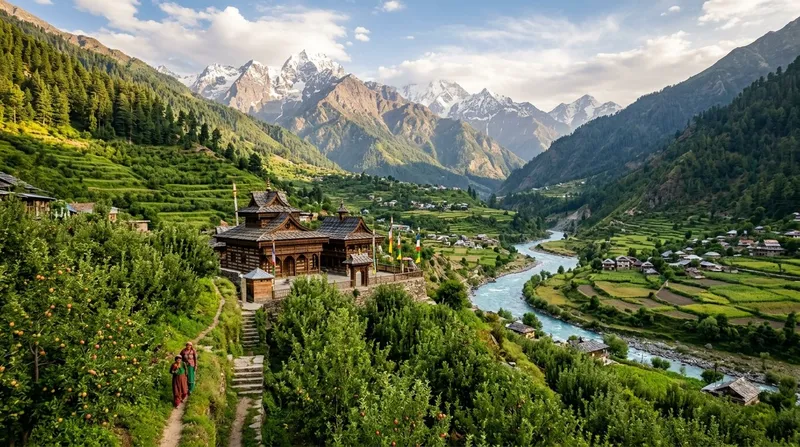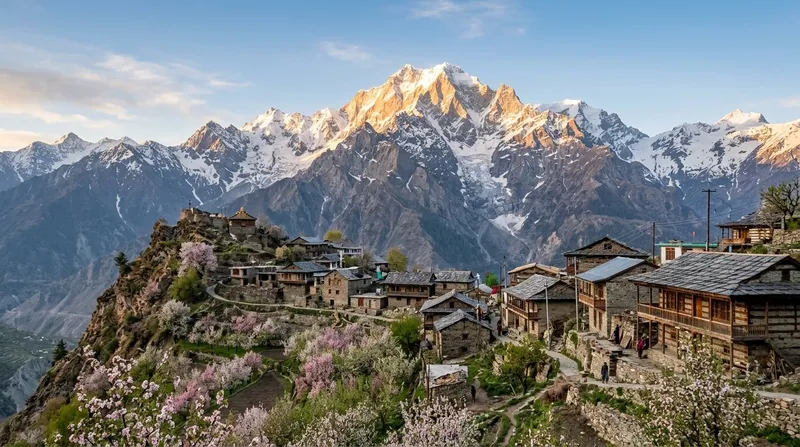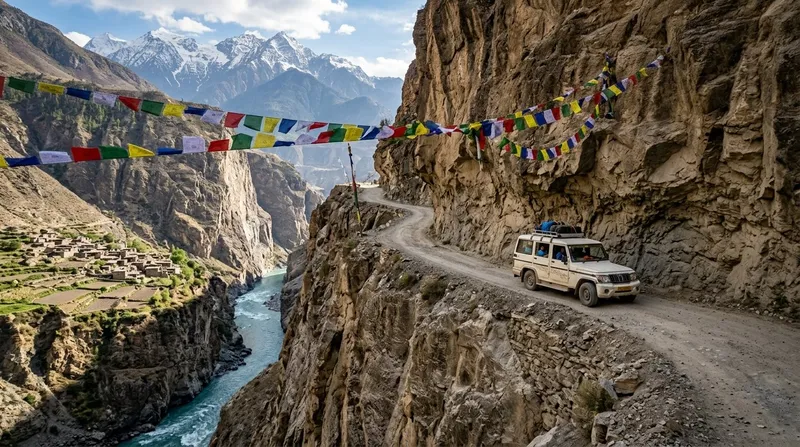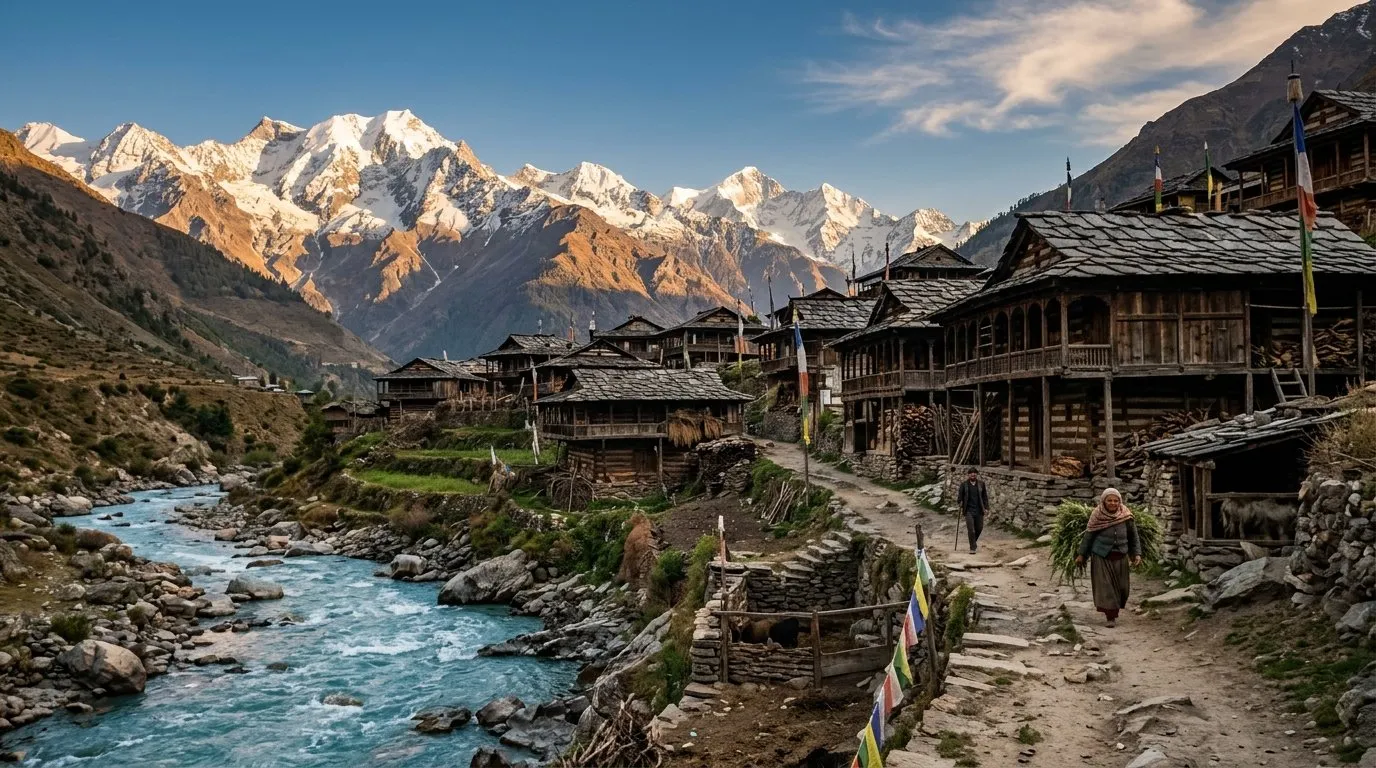
Rakcham Winter Village.
Chitkul gets all attention. Rakcham is overlooked.WHY NOBODY KNOWS
Between Sangla and Chitkul. Everyone drives through. Stop — it is equally beautiful with fewer people and more authentic Kinnauri life.
DISPATCH · ISSUE Nº 47
The last inhabited village before the Tibet border — where India ends and the mountains begin.
VERIFIED APR 2026 · ISSUE Nº 47
4 MIN READ·Or skip to the verdict ↓
“The last inhabited village before the Tibet border — where India ends and the mountains begin.”
WHY SPECIAL
India's last village on the old Hindustan-Tibet road. Wooden houses, a 500-year-old temple, the Baspa river roaring past, and the fact that you can't drive any further toward China.
Know before you go
Every month rated on the 0–10 editorial scale. Click any cell to read the month-specific verdict — what to do, what to skip, what crowds you'll meet.
↑ Tap any month for the full read · colours match verdict bands
Read our scoring methodology →
ELEVATION
India's last village on the old Hindustan-Tibet road. Wooden houses, a 500-year-old temple, the Baspa river roaring past, and the fact that you can't drive any further toward China.
If
You develop a mild headache, nausea, dizziness or loss of appetite above roughly 2,500m within 6–24 hours of arrival.
Then
Stop ascending. Rest at the current altitude for 24–48 hours. Hydrate aggressively. If symptoms worsen or fail to improve, descend 500m and seek medical help. Never ascend further while symptomatic — HAPE and HACE kill quietly.
Full protocol →
If
Your UPI apps return Server Error or Bank Unavailable repeatedly, and no card reader is in sight.
Then
This is the default state in most border valleys, not an emergency. Carry at least ₹10,000 cash in mixed denominations for any trip above 2,500m or off a state highway. Withdraw at the LAST reliable ATM — usually the district HQ — because village ATMs are ornamental.
Full protocol →
Every destination carries trade-offs. The cards below score the practical ones: confidence in the data, kids-suitability, solo-female read, and the emergency floor.
Homestays and guesthouses, book ahead in peak season options ()
Limited rooms — 15-20 stays total in village
Nearest: Sangla 25km or Reckong Peo 70km
EV charging: Not available
Freezing nights even in summer — carry warm layers
Hospital: Reckong Peo District Hospital 70km
Police: Sangla Police Station 25km
Rescue: SDRF HP / ITBP
Ambulance: 108 (2+ hours response)
Helpline: HP Tourism 0177-2652561
KIDS · FAMILY READ
HIGHLIGHTS FOR KIDS
REASONS
CONCERNS
Remote, high altitude, basic medical facilities — not safe for young children
India's last Hindustan-Tibet-Highway village before Tibet — Kinnaur's 3,450m Sangla end. HPTDC Kinner Kailash + Banjara camps. Weekend crowd + solo travellers present.
Chitkul at 3,450m is the last inhabited village on the old Indo-Tibet trade route and the last Indian village before the Tibetan border. The Mathi temple here has a deity that the village believes protects the border. Villagers are ethnically Kinnauri with Tibetan influences — they follow a mix of Hinduism and Buddhism. The village is covered in snow for six months and accessible only May to October.
Warm trekking clothing essential — temperatures drop significantly even in summer. Respectful dress in the village. Cover up at the Mathi temple. Remove shoes at religious sites.
Very limited — a few homestays and small restaurants serve basic food (rajma-chawal, dal, momos). Safe and freshly cooked. Carry snacks. Bottled water recommended but local spring water is generally clean.
Cash only. No ATMs in Chitkul. Nearest ATM is in Sangla (25 km) or Reckong Peo (45 km). Carry all cash needed.
low — villagers speak Kinnauri and Hindi. Very limited English. Younger homestay operators may speak basic English.
BSNL is the only carrier that works, and even that is intermittent. Jio and Airtel do not function. Expect to be offline.
Delhi — approximately 570 km by road
Standard Indian e-Visa covers Chitkul. Inner Line Permit was previously required but has been relaxed for Indian nationals. Foreign nationals should check current ILP requirements at the Reckong Peo DC office as rules change frequently.
EMERGENCY · SOURCE-VERIFIED
Marker at India's last inhabited village before the Tibet border. Iconic photo spot at 11,319 ft.
Ancient wooden temple dedicated to the local deity Mathi with exquisite Kinnauri wood carvings.
Scenic walk along the Baspa River with views of snow-capped peaks and apple orchards.
NEIGHBOURHOODS · WITHIN CHITKUL
Between Sangla and Chitkul — equally beautiful but everyone drives past
Most people drive through Rakcham on the way to Chitkul and never stop. Their loss. Quieter, equally dramatic Baspa valley views, a few homestays, and none of Chitkul tourist crowd.
More facilities than Chitkul, equally beautiful, and Kamru Fort above
Sangla is the main town in the Baspa Valley. More hotels, restaurants, and an ATM (sometimes working). Kamru Fort overlooks from above — ancient wooden architecture, permission needed for inner sanctum.
HIDDEN GEMS · 3 NEAR CHITKUL
Chitkul gets all attention. Rakcham is overlooked.WHY NOBODY KNOWS
Between Sangla and Chitkul. Everyone drives through. Stop — it is equally beautiful with fewer people and more authentic Kinnauri life.
Cross the Baspa River on a traditional wooden bridge to Batseri village. Kinnauri architecture, weaving workshops, zero tourists. The bridge itself is photogenic.
Walk toward last point of India. Wildflower meadows in July. Himalayan marmots. Baspa narrows to crystal stream.
OR INSTEAD · NEIGHBOURING READS
How Chitkul stacks against the closest alternatives.
WHAT A DAY ACTUALLY COSTS
Last Indian village on Indo-Tibet border; remote location adds transport cost; limited stays; permits needed
WHAT CROWDS LOOK LIKE
Last inhabited village on Indo-Tibet border. Road closes Nov-Apr. Instagram popularity has increased summer crowds.
INFRASTRUCTURE · ON THE GROUND
Shared jeeps from Sangla to Chitkul ₹100-150 per person, private ₹1200-1500 round trip. No Uber/Ola in Kinnaur at all.
Homestays dominate. Advance booking essential June-July + October. Most close Nov-April (heavy snow).
Carry cash — UPI unreliable in Kinnaur. ATMs only in Sangla + Reckong Peo. Minimum ₹5000 cash for a 3-day trip.
No ATM in Chitkul. Nearest: Sangla (often empty), Reckong Peo (reliable). Withdraw in Shimla before driving up.
Chitkul has 6-8 shops + 4-5 dhabas. All close by sunset (around 6pm winter). No nightlife.
Kinnauri dialect locally. Hindi understood. Very limited English outside homestays. Most locals are helpful despite language gaps.
Very patchy. BSNL works better than Jio in Chitkul. Airtel + VI mostly dead. Download offline maps before coming.
HOW TO REACH
AIRPORT
Shimla / Chandigarh
RAIL
Shimla / Kalka
WHERE TO EAT · 5 VERIFIED PICKS
Signature: thali with hot chai
The roadside dhaba that has trademarked itself as 'India's last' — sat at the village entrance near the Chitkul bus stop, overlooking the Baspa river. Family-run. The board, the photo-op, the small-glass chai is the reason every Spiti circuit road-trip stops here.
Tip: Order the chai in the transparent small glass — that's the dhaba's signature, not the food. Food is honest dal-rice and noodles; arrive between 11am and 4pm when the kitchen is actively cooking, not just reheating.
Signature: Kinnauri pancakes with Baspa trout
The in-house cafe at Zostel Chitkul, three-storey wooden build with open-air seating that pulls the Baspa valley straight onto the table. Chef Sachin runs a rotating daily menu using locally sourced produce; trout comes from the river below.
Tip: The menu changes daily — ask what just came in from the village before ordering. Zostel guests get priority but walk-ins are taken when seats are free; come for breakfast if you want a chair without waiting.
Signature: Kinnauri home thali
Run by Jai Singh Negi, a Kinnauri family homestay where the kitchen serves what the family is eating that day. Siddu, ogla (buckwheat) roti, chana madra — local dishes that Chitkul's tourist cafes mostly skip. Open to walk-ins when the kitchen has supply.
Tip: Call ahead in the morning — the family cooks one meal at a time and runs out by 8pm. Ask specifically for siddu with ghee; they only steam a fresh batch on request.
Signature: Dal-rice with Chana Madra
A homestay kitchen run by a Nepali cook who works without excess oil or masala — the only place in Chitkul where you can ask for less spice and actually get it. Walk-in for outsiders is allowed when rooms aren't full.
Tip: Call ahead between 11am-3pm to confirm the kitchen is open to non-residents. Madra needs 30-min lead time.
Signature: Stuffed paratha breakfast with apple compote
Open-air deck cafe attached to Zostel that the chef runs as a near-public kitchen — the only place in Chitkul that reliably serves a hot brunch with a Baspa-valley view and accepts walk-ins from non-residents through the day.
Tip: Sit on the outdoor deck — indoor seating is cramped. December-March cafe operates limited hours when only the hostel is open. Cash preferred; UPI patchy.
WHERE TO SLEEP · EDITOR'S PICKS
Boutique Lodge
We recommend this for its stone-and-timber architecture that matches Chitkul's vernacular style and direct views of the Sutlej River gorge—the signature experience of staying at India's last inhabited village before Tibet.
“Luxury geodesic domes with skylight windows, in-room breakfast service, panoramic Himalayan views”
Homestay
We recommend homestays here because they're run by Kinnaura families who cook from their own orchards, offer real insight into apple-farming rhythms, and cost half what lodges charge for comparable comfort.
Eco-Resort
We recommend it for sitting steps from the main bazaar and the Sutlej River crossing—you can walk to the village temple, the suspension bridge, and the apple orchards within 10 minutes.
“15 river-facing balcony rooms with unobstructed Baspa River and snow-capped mountain views”
Agritourism Cottage
We recommend this for sleeping in a cottage nestled inside a working apple orchard, harvesting fruit at dawn, and eating meals sourced entirely from the property—the truest way to experience what Chitkul actually *is*.
“Library, fishing, bonfire activities; Baspa River valley location with indigenous Himalayan cuisine”
BOOK A STAY · CURATED PROPERTIES
We sit before the booking layer, not beside it — compare prices on the platforms below.
Treks, safaris and day tours — compare on the platforms below.
We don't take payment to feature any destination, stay or operator. Book through a link here and we may earn a small commission, at no extra cost to you. It never affects our scores or recommendations. Editorial policy
LOCAL LEGENDS · WHO MAKES THIS PLACE
Born in Chitkul — India's last inhabited village on the Indo-Tibet border. Shows you the ITBP checkpost, the ancient Mathi temple, and the point where the road literally ends. His stories about winter isolation (6 months snowbound) are haunting.
Run a popular hostel-homestay with 4.4K Instagram followers offering curated local experiences in India's last inhabited village near the Tibet border. Dorm beds, private rooms, and an in-house cafe.
FESTIVALS · BY THE MONTH
Post-harvest celebration in India's last inhabited village on the Indo-Tibet border, with Kinnauri dances, archery, and offerings at the Mathi temple.
Drive from Sangla (25km, 1hr). First stop: Baspa River viewpoint. Walk to the last-village signboard.
Lunch at Hindustan ka Aakhri Dhaba (literally 'India's Last Dhaba') — momos, thukpa, dal-chawal ₹200-350.
Mathi Devi Temple (locally carved wooden temple, 500+ years old). Baspa river walk.
Return to Sangla before dark — road narrows and weather can shift fast.
If weather turns
Snow closes Chitkul Oct-May. Fog reduces visibility. If weather turns on arrival day: eat at the dhaba, skip the river walk, head back.
Tap any traveler type below to see how this place feels for them.
CAUTION — drive is rough, altitude 3450m, no hospitals. OK for kids 10+ with acclimatization. Hard no for toddlers.
Best for
Literally the last inhabited village before the Indo-Tibet border — 25km from Tibet line, feels remote because it is
Best for
Mathi Devi Temple + Kamru Fort are the best surviving examples of traditional Kinnauri kath-kuni wooden construction
Best for
Spiti gets the Instagram traffic; Chitkul-Sangla is equally stunning with half the crowds
Best for
Sangla Valley apples (September harvest) are among the best in India — visit orchards, taste directly
ALSO ON NAKSHIQ
Guides
Everything the guidebook won't tell you — written for India in 2026.
Blog
Long-form reads on regions, festivals, and the offbeat circuit.
Road trips
Driving itineraries with day-by-day stops, distance, and difficulty.
Collections
Wettest places. Sacred lakes. Solo-female-safe. Curated cuts.
NakshIQ 100
India's highest-scoring places, ranked across all 12 months.
The Window
One honest spread, every Sunday. The full back catalogue.
Skip list
Overhyped places with honest alternatives.
First trip
Safety, scams, what to wear, food survival, solo female travel.
FEATURED IN COLLECTIONS
The villages that look like they belong in a travel documentary.
30 legendary dhabas on every major highway across North India. Real names, real dishes, real ratings — from Murthal to Chitkul, Yamuna Expressway to Manali-Leh.
Places where every frame is a keeper — dramatic light, layered landscapes, vibrant culture, and that golden hour magic.
Skip the Instagram spots. These are places most Indians haven't visited — raw, quiet, and unforgettable.
The edge of the map. Where the road ends and the border begins.
ROAD TRIPS THROUGH HERE
— The NakshIQ editors
TRAVELLERS' VOICE
SHARE YOUR EXPERIENCE
ASK A QUESTION