Why Kashmir in September Changed How We Score Destinations
A field report from the month most tourists ignore
Destinations in this article
The Arrival Nobody Prepared Us For
We landed in Srinagar on September 3rd expecting the dregs of monsoon — grey skies, muddy gardens, a valley winding down after summer. What we found instead was the clearest water we had ever seen on Dal Lake, Mughal Gardens so empty we could hear the fountains from the parking lot, and a temperature so perfect (22°C at 2pm) that we stopped checking the weather app entirely.
This article exists because of that disconnect. Everything we had read about Kashmir pointed to June as the peak month, April for tulips, December for snow. September barely appeared in the conversation. And yet, by every metric we track — weather, crowd density, price, infrastructure access, scenic quality — September scored higher than any other month. The data didn't just suggest it. The data was unambiguous.
The June Problem, in Numbers
June is when most domestic tourists visit Kashmir. The data explains why they shouldn't.
In June, Srinagar's average high is 30°C — hot enough that houseboats on Dal Lake become stuffy without air conditioning, and most don't have it. Hotel occupancy runs at 85–95%, pushing even mid-range rooms above ₹5,000/night. The Amarnath Yatra begins in late June, flooding the Srinagar–Pahalgam corridor with pilgrim traffic. Travel time from the airport to Dal Lake, normally 25 minutes, stretches to 90 minutes on heavy days. Shikara rides on Dal Lake become a bumper-car experience — dozens of boats jostling for photo positions at the same floating gardens.
Our June score for Srinagar: 3/5. For Gulmarg in June: 4/5 (the gondola crowds are bearable, and the meadows are green, but you're sharing the experience with a few thousand others).
These aren't bad scores. Kashmir in June is still Kashmir. But the experience is diluted by volume, heat, and logistics.
September: The Data Speaks
Here is what September looks like across our scoring dimensions:
Weather: Average high 25°C, average low 11°C. Rain probability drops to 30% (down from June's 45%). Skies are sharp and blue — the kind of clarity that makes the Pir Panjal range look close enough to touch. We recorded five consecutive days of zero cloud cover during our visit.
Crowds: Hotel occupancy in Srinagar drops to 40–50%. Houseboat rates fall by 30–40% compared to June. We had entire sections of Shalimar Bagh to ourselves on a Tuesday. The Amarnath Yatra is over. School is back in session, eliminating most family tourism.
Prices: Average houseboat night in September: ₹2,500–4,000 (deluxe). Same houseboat in June: ₹5,000–7,000. Shikara ride (1 hour): ₹400–600 in September vs ₹800–1,200 in June. Flight prices: 20–35% lower from Delhi.
Scenic quality: This is where September separates itself. The chinar trees begin their turn from green to gold in late September — it is early autumn, and the light shifts to a warm amber that photographers call "golden hour all day." Dal Lake's water clarity peaks after the monsoon flush. The gardens are in their second bloom. Gulmarg's meadows turn from summer green to a tapestry of gold and russet.
Our September scores: Srinagar 5/5. Gulmarg 5/5.
A Day on Dal Lake in September
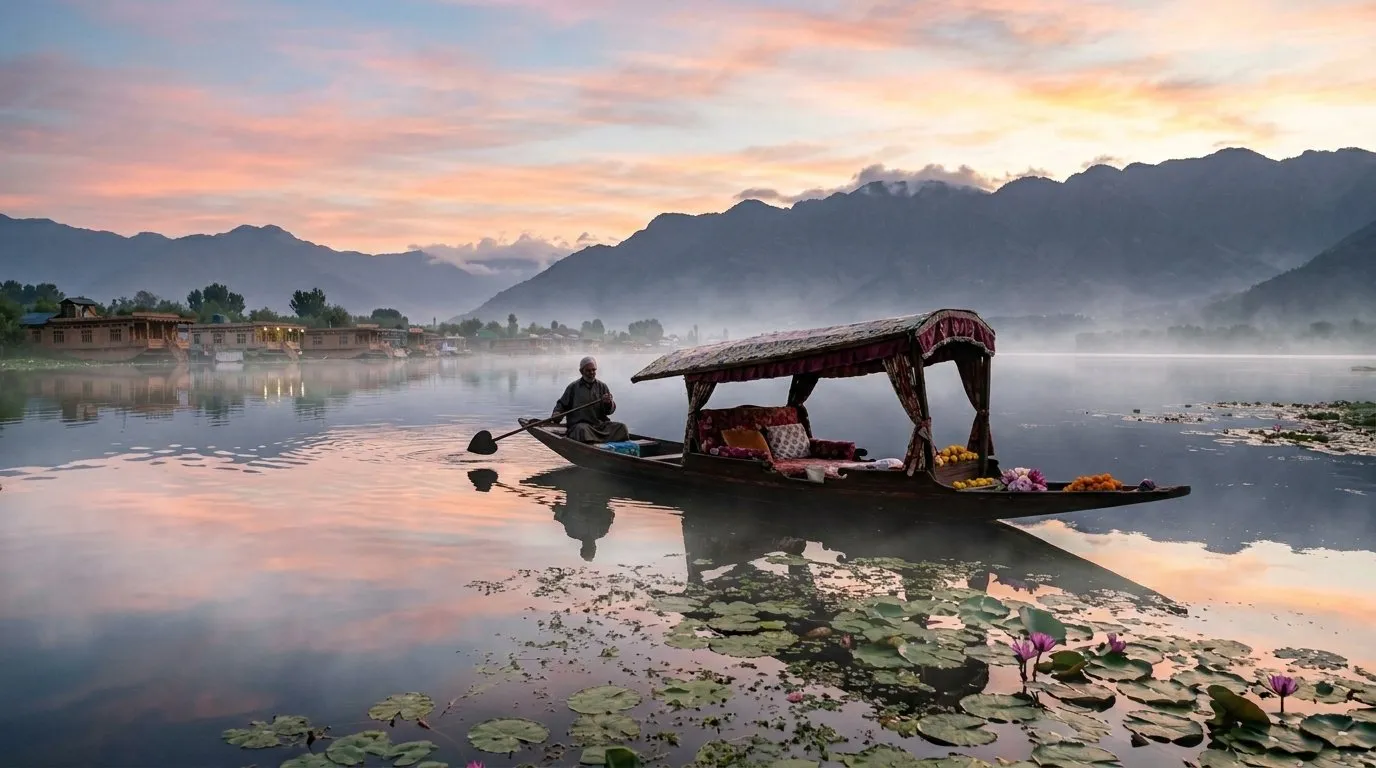
We boarded a shikara at 6:30 AM from Nehru Park ghat. The lake was glass. Mist sat on the water in thin sheets that the sun burned through within thirty minutes. Our boatman, Mohammed Ashraf, who has paddled Dal Lake for thirty-two years, said September mornings are the only time the lake looks the way it did when he was a child — before tourism reshaped the shoreline.
We floated through the floating vegetable market. In June, this market is a performance for tourists — boats jostle, prices inflate, cameras click. In September, it was just commerce. Farmers selling tomatoes and lotus stems to wholesalers. We bought a kilo of cherry tomatoes for ₹30 and ate them from the boat.
By 9 AM, we had the central lake to ourselves. No other shikara in view. The Hazratbal Shrine reflected perfectly in the water. We drifted for an hour without paddling, and the only sound was a kingfisher hitting the surface twenty metres away.
This experience is not possible in June. It is not a matter of getting lucky or waking early enough. The volume simply does not allow it.
The Mughal Gardens, Without the Crowds
Shalimar Bagh, Nishat Bagh, and Chashme Shahi are Kashmir's marquee gardens — Mughal-era terraced landscapes with fountains, chinar trees, and mountain backdrops. In June, each garden processes thousands of visitors per day. Selfie sticks outnumber flowers. The sound of fountains is buried under crowd noise.
On September 8th, we entered Nishat Bagh at opening time (9 AM). We counted fourteen other visitors in the entire garden during the first hour. The terraces stepped up toward Zabarwan hills with every fountain running. The chinar trees were beginning their colour shift — a few branches gold against deep green. We sat on the highest terrace for forty minutes. Nobody asked us to move for a photo.
At Shalimar Bagh the following day, we had a similar experience. The famous black marble pavilion, typically surrounded by a scrum of tourists, was empty enough to sit inside and listen to water move through the channels that Jahangir designed four hundred years ago.
Gulmarg in Gold
Most tourists visit Gulmarg for snow (December–February) or the gondola to Apharwat Peak (May–June). September offers something neither season can: the meadow at its most painterly.
The golf course — the highest in India at 2,650m — sits in a bowl of mountains. In September, the grass transitions from green to gold, and the surrounding birch and pine forests layer colour against the peaks. The gondola queues in September: 5–10 minutes (versus 60–90 in June). We rode Phase 1 and Phase 2 consecutively without waiting.
At Phase 2 (3,950m), the view toward Nanga Parbat was unobstructed. The September air has a clarity that the summer haze strips away. We could see peaks that our gondola operator said are invisible in June.
A round of golf at the Royal Springs Golf Course: ₹2,500 in September, with availability. In June, you book two weeks ahead.
Infrastructure Notes: What September Travelers Need to Know
Hospitals: Srinagar has SKIMS (Sher-i-Kashmir Institute of Medical Sciences) — a fully equipped tertiary hospital. SMHS Hospital in the city centre handles emergencies. Gulmarg has a small dispensary; serious cases go to Srinagar (50 km, 2 hours). Medical infrastructure in Kashmir is significantly better than most Himalayan destinations.
Network: Jio and Airtel both work reliably in Srinagar, Gulmarg, and Pahalgam. 4G coverage on Dal Lake is solid. Network drops on the Srinagar–Gulmarg road in a few spots but nothing prolonged.
Roads: Post-monsoon road conditions in September are generally good. The Srinagar–Gulmarg highway is well-maintained. The Srinagar–Pahalgam road can have minor washouts but is passable. The airport road occasionally floods but clears quickly.
ATMs: Widely available in Srinagar. Gulmarg has two ATMs (SBI and J&K Bank) — they work. Pahalgam has multiple ATMs. Cash is less critical here than in truly remote destinations, but carry ₹5,000 as backup.
Flights: Srinagar's Sheikh ul-Alam Airport receives direct flights from Delhi (1.5 hrs), Mumbai (2.5 hrs), Bangalore, Kolkata, and Chandigarh. September schedules run at full capacity with significantly lower fares than June.
The Thesis: Popular Timing Is Not Best Timing
This is the insight that changed how we build our scoring system. Before Kashmir in September, we weighted our monthly scores partly on popularity — the assumption being that peak months are peak for a reason. They are. The reason is school holidays, marketing momentum, and the self-reinforcing cycle of "everyone goes in June, therefore June must be best."
But popularity is a proxy for convenience, not quality. June is when families can travel. June is when package tours operate at maximum capacity. June is when hotel margins are fattest. None of these factors have anything to do with the actual experience of being in a place.
Our scoring now weights objective conditions — temperature range, precipitation probability, crowd density, price normalization, scenic indicators — independently of tourist volume. When we reran the numbers for Kashmir with this methodology, September pulled ahead of every other month by a margin that wasn't even close.
The revised Kashmir monthly ranking:
1. September (5/5) — perfect weather, empty landscapes, autumn beginning, low prices
2. October (4.5/5) — peak autumn colour but cooling rapidly, some services closing
3. April (4/5) — tulip season, pleasant weather, moderate crowds
4. March (3.5/5) — late snow, tulips starting, unpredictable weather
5. June (3/5) — hot, crowded, expensive, Amarnath traffic
6. July–August (2.5/5) — monsoon, heavy rain, landslide risk
7. November (2.5/5) — cold, grey, most services closed
8. December–February (3/5) — snow experience is unique but brutal cold, limited services, Gulmarg skiing lifts it
What This Means for Travelers
If you have the flexibility to travel outside school holidays, September Kashmir is one of the best travel experiences in India — arguably the best. You get the full Kashmir at a fraction of the price and a fraction of the crowds, with better weather than the "peak" season.
Book houseboats directly (not through aggregators) for September rates. Fly midweek for the lowest fares. Spend at least two nights on Dal Lake — the early mornings are the whole point. Add Gulmarg for a day trip or overnight. Consider extending to Pahalgam for the Betaab Valley and Aru Valley, both of which are stunning in early autumn.
And if someone tells you September is "off-season" for Kashmir, show them the data. The lake doesn't lie.
The Window · Every Sunday
Liked this? Get one every Sunday.
Best score of the week, one honest skip, road updates. Four minutes. No spam.
More in Data Story
7 offbeat himachal pradesh destinations scored 5/5 for May 2026
May is the month Himachal Pradesh stops being a gamble. Snow has cleared, passes are open, and the weather window is wide enough to actually plan around. A 5/5 score means the destination is firing on all four cylinders this month — weather, trail access, infrastructure, and crow
6 min read
The State of Indian Travel: Q1 2026
NakshIQ's Q1 2026 quarterly data report — 215 destinations, 2,580 monthly scores, and the data-driven truth about where India actually traveled in January through March 2026.
15 min read
The Monsoon Intelligence Report
A data-driven analysis of 124 Indian destinations during monsoon season, revealing where rain helps, where it's dangerous, and the 26.7% of destinations that peak during July-September.
11 min read- Access
- Good paved road.
- Emergency
- 108 · PHC Gulmarg. Srinagar SKIMS 56km.
- Stay
- ₹2000-15000/night · 50 options
Go with confidence.